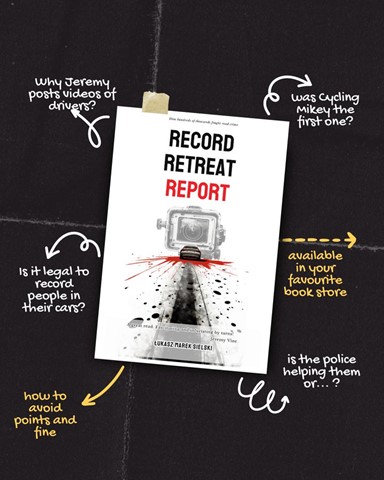
In my book reviews, I often urge supporters of Road Danger Reduction to read the book I comment on. This book is one which should not only be bought but used as a campaigning tool for engagement with your local “road safety” professionals and/or your UK Police Service. It’s nominally about a niche area of activity – 3rd party reporting – but the reaction to it tells you a very great deal about driver law-breaking and how we can challenge it.
That’s the key issue here. While the way in which liaison with your local Police can help in cutting specific types of road danger (close passing of cyclists, phone use and in the future speeding) varies, what really counts for me is the massive and hysterical reaction from driver bigots to those involved with 3rd party reporting.
I’ll be concentrating on these and other issues arising from 3rd party reporting, rather than just describing Sielski’s history of the practice in the UK.
1. Move UK away from dependence on private motor transport, which is unsustainable, wasteful, unsafe and is a deterrent to walking and cycling, by incentivising sustainable, active travel and public transport and by deterring unnecessary motor vehicle use by road pricing.
2. Cut the road building budget (c. £7 billion*) and reallocate for sustainable transport including:
£2 billion p.a. for Active Travel routes to deliver target of 50% of urban trips on foot or by bicycle by 2030.
3. Enforce road traffic law effectively through a substantial increase in roads policing, including national support for 3rd party reporting, with emphasis on minor penalties for common offences implicated in causing death and injury to others. Allocate an additional £500 million p.a. to be spent on road traffic policing.
4. Implement a National Road Safety Strategy with headline targets to reduce the danger that road users can pose to others, the establishment of a Road Safety Investigation Branch and lower speed limits with default of 20mph on urban roads and 40mph max on country lanes.
5. Legislate for and incentivise use of smaller, slower, safer, sustainable motor vehicles for passengers and freight. Taxation should be based on vehicle size, weight, and fuel with an objective being the reduction of use of SUVs in urban areas.
6. Commission a review of all road traffic laws to secure “roadjustice”.
Road Danger Reduction Forum President Baroness Jenny Jones said:
“Victims of road crashes – whether those injured or those who have lost loved ones – suffer appallingly, not least with an often overly lenient attitude in the justice system. The only civilised approach to this is to reduce danger at source – from those with the potential to hurt or kill others”, says Baroness Jones.
“Measures to curb road danger have to be part of a transport policy – unlike the one we have had for decades – which is less car dependent, and which supports active and less polluting forms of transport: this can also cut the deaths from inactive lives and vehicle emissions, as well as those from road crashes.”
It’s not right to expect children to wear body armour and high visibility clothing to (supposedly) protect themselves, while adults with a ton of metal around them are permitted to get away with dangerous and unnecessary driving which scares them off the streets.”
For further information, or if you want your organisation to sign up to the Manifesto, contact:
We’ll be commenting further here and on @CHAIRRDRF about other Manifestos, why ours is different and what we have in common. 19th June 2024
*The 2nd Roads Investment Strategy (RIS2) was £27.4bn when it was first announced in March 2020 (and that was to cover the 5 years from April 2020 to March 2025)to £24bn in the October 2021 Spending Review. About £14.1bn of it was for actually building new road capacity. The roads budget for beyond March 2025 (i.e. RIS3) has yet to be set – we believe that there should be a presumption against creating new capacity which will induce or generate more motor vehicular traffic.
(This article appeared in the 19th July 2019 issue of Local Transport Today as “Viewpoint” – online here)
Last week Lord Berkeley retired after 26 years as President of the Road Danger Reduction Forum (RDRF). So what has been achieved since we were set up in 1993? Is road danger being properly addressed? And since governance of policy on safety on the road is always part of wider transport policy, is the way our society views transport what we need for the 21st century? Despite some positive developments, the answer for both is no.
In our Charter we give a commitment to: “Find new measures to define the level of danger on our roads. These would more accurately monitor the use of and threat to benign modes.” This post is part of our work at doing that – hopefully it will contribute to debate. It is based on a document by PACTS given to the Transport Committee Active Travel enquiry in December 2018.
In previous posts and discussions, we have spent a lot of time talking about the need to have measures and targets for benign transport modes expressed with a measure of exposure – e.g. casualty rates per distance, or time, or number of trips travelled. Examples are here and here . In this post we move on to look at the question of: Who Kills/Hurts/Endangers Whom?
This post may seem a little late, based as it is on an Editorial in The Times from August 25th. Nevertheless, as with other comments arising from the Alliston case (here and here) its subject tells us some very revealing things about the way road user behaviour is either accepted or stigmatised by the society we live in. Any serious attempts to reduce danger on the road involve a proper conversation about what we should or shouldn’t tolerate in the road environment. So let’s take a look at The Times instruction.
For us the highlight of 2016 – and indeed for a longer period – is the policing of close passing of cyclists by West Midlands police , to be followed by similar policing by Camden MPS, and our award recognising this work. While, in itself, the enforcement exercise of “Give Space: Be Safe” won’t make a difference for the average cyclist in the UK, it is noteworthy for a number of reasons. As we say in the post, this policing recognises:
(a) The fundamental difference in the effects on others of errant behaviour by drivers on the one hand and cyclists on the other, and accordingly focusing on the driver misbehaviour.
(b) That behaviour which is intimidatory and deters potential cyclists from cycling – in this case close passing/overtaking – is worth addressing even if it is not just linked to causation of Killed and Seriously Injured casualties.
In other words, both approaches take a “harm-reduction” – or as we would say, danger reduction – approach. The award event at the House of Lords was packed out by campaigners, transport professionals and police officers. Cycling UK have referred to “Give Space: Be Safe” as “the best cyclist safety initiative by any police force, ever”
I have tweeted about the current campaign by the FIA (the international motorists’ organisation) using Formula One racing drivers to tell children to wear hi-viz clothing when walking. It’s had a lot of re-tweeting and comments, not least directed at practitioners with a road safety remit . For some of us, this is just a matter of sighing that “you couldn’t make it up”. Others have argued that there is no evidence that campaigns like this will actually protect children. For many this is just a seasonal irritation – or even a partially useful intervention – to be accepted while we try to get on with the business of real road safety – reducing danger at source.
But we believe that this kind of intervention tells us a lot about what is going wrong – and what needs to change – if we are to have a civilised approach to road safety.
In the transport practitioner’s fortnightly journal Local Transport Today (Viewpoint, LTT 704), Professor Richard Allsopp – a key figure in Britain’s “road safety” establishment – made a critique of the “Vision Zero” movement. While we have some issues with the Vision Zero approach, we find it necessary to criticise Professor Allsopp’s article, featuring as it does some key features of “road safety” ideology. Here is our response as printed in Local Transport Today 705:- Continue reading →
I’m aware that there is something of a London-centred bias in our posts. Nevertheless, what Transport for London does is of special interest to transport professionals and campaigners throughout the UK: while it is the Highway Authority for only a small minority of London’s roads, it has massive influence through its funding of Boroughs throughout London. With a dire record of (in)action on sustainable transport in the UK’s central Government, London is often where we have to look for potential progress.
So when TfL has peppered its current strategy “Safe London streets: Our approach” with references to danger reduction, and called its 2016 annual conference on March 4th “Tackling the Sources of Road Danger”, it’s time to take notice. Is TfL really moving from “road safety” towards reducing danger at source? Continue reading →
Should an advocate of Road Danger Reduction appear on Top Gear? Back in 1993 the programme was reasonably civilised and I was pleased to appear on it. So here is the current Chair of the Road Danger Reduction Forum explaining a basic point about the measurement of danger.


 Road Danger Reduction Forum