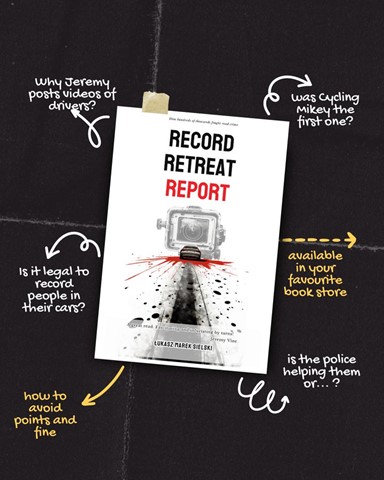
REVIEW: “Record; Retreat; Report” by Lukasz Marek Sielski.

Anybody who can make it to becoming a tabloid journalist should be aware of basic history or the law. So when Liddle states that “Cars were there before cyclists” – er, no. You may need to present the bigots with the facts (when I was three years old there were more miles travelled by bicycle than by car, let alone journeys, in the UK), but what’s noticeable is the ease with which a sentient human being can slip into idiocy. Similarly the vile Clarkson stating “Roads. Are. For. Cars.” (Note the use of those full stops!) could do with an education about, how, as the book says: Roads were not built for cars.  And the view stated (but not enough) by police officers and others that all road users have a right to be on the road.  But that’s not the point. The point is the danger of wilful bigotry.

The History

How did it begin?

Sielski details the history of 3rd party reporting: How we have the technology through various iterations of video cameras, and then the people who started using them like David Brennan (Magnatom) and several others (pp.42-43). Then there’s the legendary Cycling Mikey, a key contributor to our 30th anniversary webinar , see him here on video at 49.51 minutes. Their activities were notable for attracting vile abuse from some journalists – abuse which, as I pointed out above, can actually have dangerous consequences for others.

Ant then along came Jeremy Vine. Check out pages 70–96 for the story of how the affable broadcaster became a celebrity cyclist. For me, the point is precisely not that he is some sort of attention-seeker with a special cause to promote. Basically, I see him as someone who is just trying to get to work using what would be seen in many European countries as a normal form of transport, and which was commonplace for commuting in the UK not many decades ago. He has noted that on more occasions than one should expect, his safety is compromised by illegal behaviour by other road users. So he reports it to the police and mentions it on his media outlets.

That’s it, really.

As he says: “I think the main way to get greater safety is through enforcement, but I’m not worried about the police workload because I think we’re saving them work, actually… when we prevent a person from killing somebody further down the line”. (p.89).

We like Jeremy.

The police…

All this requires positive and user-friendly responses from the UK’s 26 police services. We’re pleased that Road Danger Reduction Forum has organised training seminars such as this and summaries of the state of play on 3rd party reporting and the associated enforcement of close passing of cyclists, with the publicity from police social media accounts. Here we get summaries of how different police services have operated, with references to our RDRF friends (now Detective Chief Superintendent) Andy Cox and former traffic PC Mark Hodson. (pp.97–115)

Here’s Andy Cox: “In any other crime – sexual assault, burglary, violence – we ask the public to come forward with information. The fact we weren’t doing that for road crime was wrong”. (p.115)

An aside: If I’m referencing the work that RDRF has done in this area, it’s not a criticism of this book that we don’t get mentioned. There have been a number of channels through which the messages about 3rd party reporting and close pass policing have been mentioned, including the weekly webinar Active Travel Café and the national cyclists’ organisation Cycling UK. This book gives a detailed history in one place – one of the reasons you should buy it.

…and the justice system.

There’s a nice chapter here (p.117–129), although the “weapon of choice” trope (p.127) should be avoided – the whole point about road crime is that in the vast majority of cases, we’re concerned about types of negligence, carelessness or recklessness. They don’t have the high levels of intentionality required for deliberate murder: that doesn’t mean that sanctions such as (shorter) prison sentences and above all licence withdrawal shouldn’t be employed.

So where do we go now?

There’s a need for uniform approaches to be taken by police forces across the UK – at present the responses (including feedback to submitters) are highly variable. Hopefully work carried out by DCS Cox with the National Police Chief Council (NPCC) Road Crime Reporting Working Group will result in progress. Our friends at Action Vision Zero  https://actionvisionzero.org/  assist actual or potential 3rd party reporters: see Paragraph 4 here https://actionvisionzero.org/action-vision-zero-roads-policing-campaign/ .(Also the report here https://actionvisionzero.org/2024/08/01/reporting-road-crime-police-hear-from-cycling-campaigners/ ).

A question of culture

For me the key issue has been about the reaction to 3rd party reporters as discussed at the beginning of this post: it reveals the extent of fragility and panic amongst people who are just not prepared to accept responsibility when driving. It’s a deep-seated ideology which tends not to be discussed, let alone questioned. In this case it’s a panic about potential “punishment” which isn’t much of a punishment, but which might deter possible law-breakers from endangering other road users more than they already do. But it crops up throughout any discussion about transport policy or danger on the road, and it needs to be tackled.

One area where campaigners (I’m not happy about the word – I don’t see why people who would like some laws enforced should be seen as such) could get involved is with their local Road Safety Partnerships and with Council Road Safety Officers. There is already a history of community involvement with Community Roadwatch (formerly Community Speedwatch), and this should be part of that kind of work.

In fact, if Road Safety Officers were genuinely committed to reducing danger at source, it’s the kind of work they should welcome being involved with. Yet, although a former RSO (Teresa Healy) was involved in setting up Operation Snap, there doesn’t seem to be active promotion of 3rd party reporting by RSOs.

As followers of www.rdrf.org.uk and @CHAIRRDRF know, I am critical of much of what passes for “road safety” culture. I noted this above the dedication at the beginning with some (clumsy) green highlighting:

The fact is that for highway engineers in the official “road safety” community, the correct response will indeed include felling the tree. (See the discussion here and also here).

What we’re up against is a culture of accomodating driver rule- and law-breaking which is embedded among all too many “road safety” professionals. That doesn’t mean that none will be interested in supporting initiatives like 3rd party reporting (many are), and that you shouldn’t approach them.

So if you’re interested, why not approach your local RSO and ask for assistance with publicity (a key element of the success of 3rd party reporting is that drivers are aware that they may be caught when breaking the law)? And do let us, Action Vision Zero and others know what response you get.

Ultimately, it’s a question of whether driving carelessly or dangerously is socially acceptable. The story of the pioneers described in this important book is a story of people for whom it is not. The bigoted reaction to them is an indicator of an area where our society remains uncivilised.

And as for that reaction? Let’s end with Sielski giving us a quote from Victor Hugo:

“Do you have enemies? That’s simply the fate of anyone who has done anything worthwhile or launched any new idea. It’s a necessary fog that clings to anything that shines. Fame must have enemies, as light must have gnats. Don’t worry about it; just have contempt. Keep your mid serene as you keep your life clear”.

Dr Robert Davis, Chair RDRF.

Record; Retreat; Report” by Lukasz Marek Sielski. For more information on the book go to www.phonekills.com or www.sielay.com

Road Danger Reduction Forum: Manifesto 2024

1. Move UK away from dependence on private motor transport, which is unsustainable, wasteful, unsafe and is a deterrent to walking and cycling, by incentivising sustainable, active travel and public transport and by deterring unnecessary motor vehicle use by road pricing.

2.   Cut the road building budget (c. £7 billion*) and reallocate for sustainable transport including:

£2 billion p.a. for Active Travel routes to deliver target of 50% of urban trips on foot or by bicycle by 2030.

3.   Enforce road traffic law effectively through a substantial increase in roads policing, including national support for 3rd party reporting, with emphasis on minor penalties for common offences implicated in causing death and injury to others. Allocate an additional £500 million p.a. to be spent on road traffic policing.

4.   Implement a National Road Safety Strategy with headline targets to reduce the danger that road users can pose to others, the establishment of a Road Safety Investigation Branch and lower speed limits with default of 20mph on urban roads and 40mph max on country lanes.

5.   Legislate for and incentivise use of smaller, slower, safer, sustainable motor vehicles for passengers and freight. Taxation should be based on vehicle size, weight, and fuel with an objective being the reduction of use of SUVs in urban areas.

6.   Commission a review of all road traffic laws to secure “road justice”.

********************************************************************

Road Danger Reduction Forum President Baroness Jenny Jones said:

Victims of road crashes – whether those injured or those who have lost loved ones – suffer appallingly, not least with an often overly lenient attitude in the justice system. The only civilised approach to this is to reduce danger at source – from those with the potential to hurt or kill others”, says Baroness Jones.

Measures to curb road danger have to be part of a transport policy – unlike the one we have had for decades – which is less car dependent, and which supports active and less polluting forms of transport: this can also cut the deaths from inactive lives and vehicle emissions, as well as those from road crashes.” 

It’s not right to expect children to wear body armour and high visibility clothing to (supposedly) protect themselves, while adults with a ton of metal around them are permitted to get away with dangerous and unnecessary driving which scares them off the streets.”

For further information, or if you want your organisation to sign up to the Manifesto, contact:

Dr Robert Davis, Chair RDRF, at chairrdrf@aol.com

We’ll be commenting further here and on @CHAIRRDRF about other Manifestos, why ours is different and what we have in common. 19th June 2024

  • *The 2nd Roads Investment Strategy (RIS2) was £27.4bn when it was first announced in March 2020 (and that was to cover the 5 years from April 2020 to March 2025)to £24bn in the October 2021 Spending Review. About £14.1bn of it was for actually building new road capacity. The roads budget for beyond March 2025 (i.e. RIS3) has yet to be set – we believe that there should be a presumption against creating new capacity which will induce or generate more motor vehicular traffic.

WEBINAR: “Road Danger Reduction Forum: Celebrating our 30th Anniversary”. Monday 11th December 2023

As from December 27th 2023 the recording of this webinar is available here:

         Monday 11 December 2023: 1400-1600

PROGRAMME

Introduction

Baroness Jenny Jones (President RDRF) “Welcome !” 

Dr Robert Davis (Chair RDRF) : “30 years of RDRF, why we were set up – and what are our achievements?

Session 1  Harm Reduction: Enforcement

Amy Aeron-Thomas (Action Vision Zero) : “Harm reduction – progress achieved over 30 years”.

Detective Chief Superintendent Andy Cox  (Metropolitan Police) : “Speed reduction and tackling dangerous driving”.

Former PC Mark Hudson (MPH Collective) : “Close Passing Operations The relevance of Enforcement.”

  Cycling Mikey (3rd Party Reporting Campaigner) : “Third Party reporting”.

Sara Dowling (RoadPeace) : “The importance of Road Justice”.

Q& A      

Session 2  The Role of Active Travel 

Lucy Saunders (Healthy Streets) : “How healthy streets encourage active travel“.

Stephen Edwards  (Living Streets) : “How more people walking makes streets safer, and safer streets make more people walk”.  

Tom Bogdanowicz (London Cycling Campaign) : “How cycling makes streets safer”.

Q& A      

Session 3 Removing danger by reducing motor traffic

Brenda Puech (RDRF) :  “LTNs and other measures to reduce motor traffic”.

Roger Geffen (Low Traffic Alliance) : “Traffic reduction affects Climate Change and pollution – not just road danger”.

Q & A

Dr Robert Davis (Chair RDRF)    Closing Words.

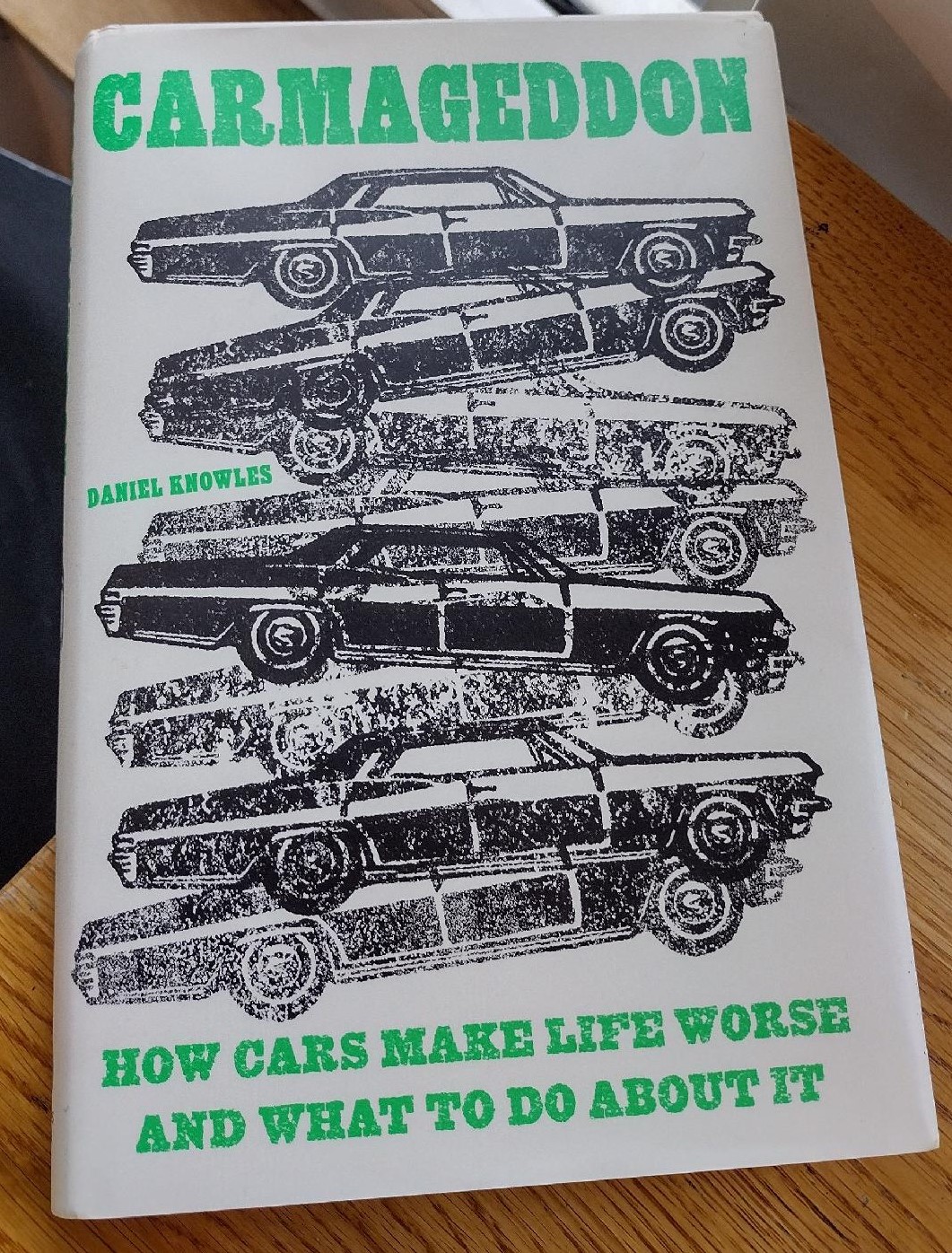
BOOK REVIEW: “CARMAGEDDON: How cars make life worse and what to do about it” by Daniel Knowles

This is an absolutely “must read” book for anybody trying to make sense of a car dependent society and working out ways to mitigate the adverse effects of car use. The author is an experienced and proficient journalist basing his work on worldwide case studies in an easy to read style: making things simple without being simplistic. I disagree on a couple of minor points (HS2 is one), and there’s one big flaw in the structure of the book (wait for it!), but you really should read this book if you have any interest in road transport.

The aim of this book is to persuade you of something that is antithetical to the development of most of the world over the past 140 years”(p.4) …and he does this nicely, refusing to avoid issues about why cars are so attractive, just recognising that “The problem is that cars impose costs on everybody else”. (p.8).

And some more quotes from the Introduction: “Cars are not just about how you get around. They are about what the city you live in looks like and what your daily life feels like. The car goes to the core of almost everything…. the car effects almost every aspect of our lives. But it can change. And when you cut back on the car, you discover that, in fact, you never needed it as much as you had thought. This book will explain how that it is possible” And (to a large extent) it does.

So let’s have a tour through the book:

It kicks off with an account of Texas (transport across the state of Texas accounts for 0.5% of the entire world’s CO2 emissions, p.16). Knowles considers the process of increased motorisation – correctly and necessarily in my view – by describing the links between development (housing, retail, workplaces), road building and the cheap costs of buying and running cars. He describes the economists’ view of “externalities” (allowing us to show how, in effect, car use is subsidised), the “prisoner’s dilemma” of the consequences of everybody working in their own interests, and how urban density in car dominated societies declines to create an even more car dependent society. Most importantly, this pattern has already started throughout the “less developed” world and: “…unless we deal with the car, climate change is going to prove unstoppable” (p.23)

There’s a nice short section on the early history of motorisation (the invention of the term “jaywalking” by the American section of the “road safety” industry) followed by one on the history of road building. I liked reference to my colleague and mentor John Adams work on “predict and provide” from the 1980s.

But here’s the problem: the book is packed with mentions of numerous pieces of academic research and surveys. It refers to crucial evidence – but without reference to the original work. That means that readers who want to examine the original work, or refer to it in their own writings, simply can’t do so without a difficult trawl through search engines – even titles of the original material are absent. To make matters worse, while some of authors are mentioned in the (short) index, others – like Adams – are not.

These are crucial flaws. One must hope that when this book comes out in paperback, or a second edition, that there is a full reference system and better index.

Back to the content. Our world tour takes us through Detroit and how motorisation accompanied the “white flight” from city to suburb. Then we have the history of the Moses/Jacobs fight: I think Jane Jacobs is unfairly described (as she was in David Hare’s recent play on this episode) as a “gentrifier” (p.75). Gentrification is, after all, something which happens when an area becomes more attractive, as it will when it doesn’t have a motorway running through it.

EVs get a nice roasting as “THE solution” (yes, I know EVs are better than ICE cars, it’s just that we can’t merely replace the latter with the former and expect to address ghg emissions plus all the other problems of excessive car use): “The problem is that electric cars are popular precisely because they provide an excuse to avoid doing the harder things, like rebuilding our cities, or changing the habits of a lifetime” (p.99). I think Knowles spends a bit too much time on the “rare earth” issue – there are enough other problems associated with the “EVs are the solution” trope, as I’ve described here: https://rdrf.org.uk/2019/10/28/whats-wrong-with-electric-cars-are-they-a-small-step-forward-or-a-red-herring/ .

The next chapter introduces us to the fascinating concept of “bionic duckweed”: “…a technology that may never materialise because it is not a real technology at all”. This is a wonderful concept in my opinion – do read about it yourselves (spoiler: think AVs).

Next up, a swift run through induced demand (“Traffic engineers cannot resist trying to fix congestion with one more road…exactly why you should not put engineers in charge of social problems, like how to get people around.” P.117); the problems of “free” parking; and the machinations of the car industry – yes, we’re right to be suspicious of it.

Naturally, I have a particular interest in the chapter “What causes traffic accidents?” (shame about using the “a” word though Daniel). It’s nice to see that at least some of his discussion includes consideration of risk compensation by drivers: the consideration of US street design (yes, correctly in my view) states:”…what America’s wider streets mean, in effect, is that drivers feel safer going faster.” (p.162) and “A basic rule of cities is this: if it is a relaxing place to drive, then it is invariably a god-awful place to walk”(p.166).

The last chapters in the book discuss the solutions, starting with one on bicycles and (I learned a lot from this) the example of Japan, and (some) changes in young people’s attitudes towards cars, ending with:” A world in which cars are less necessary in our daily lives, and less dominant in our cities, is possible. We just have to find a way to get there”.(p.225). Knowles concludes by stressing that political courage is vital, and that: ”There can never be enough road space, enough parking spaces, or enough gasoline for everyone to have one, and for it not to be miserable.”(p.235).

Readers of posts on www.rdrf.org.uk will be familiar with much of what is written here, but probably not all – and it’s good to see it presented in an attractively written way. But even if you feel you don’t need to read it, you’ll probably have acquaintances who do – so buy a copy for them at least! Hopefully the next edition will have a good reference system and better index.

Robert Davis 7th August 2023

We’re still here and busier than ever!

RDRF supporters may have noticed that there has been an absence of blog posts here (leaving aside a book review and details of our conference) for two years. That doesn’t mean we haven’t been active – far from it. The main reason for no posts is that my activity in monitoring and responding to transport issues formed during the COVID-19 crisis has been through the weekly webinar for Active Travel professionals and campaigners www.ideaswithbeers.co.uk  (more of which below).

And our other RDRF Committee members have been busy with:

Brenda Puech: Continuing work as a disabilities/inclusive access consultant and carrying on her pioneering work on Street Parklets with London Living Streets.

Lucy Marstrand-Taussig: Lucy has been working as a consultant for Active Travel England, specialising in work with women and children.

Ken Spence: With the Transport Initiatives team Ken has been working on Local Authority Local Cycling and Walking Implementation Plans (LCWIPs).

Colin McKenzie: The team at LB Ealing he works in has implemented wand-protected (light segregation) cycle lanes on main roads, and despite a pull back on LTNs, some with key cycle route links in Ealing have been retained.

Ideas With Beers

While working in Manchester, Brian Deegan (long term highway engineer working on creating cycling and walking friendly environments) had an informal discussion session for engineers and other colleagues after work. When the first lockdown hit and the transport world was buzzing with measures taken worldwide to re-allocate road space, this shifted to an online weekly webinar.  The name chosen, as the first real world meetings were held over a post-work drink, was “Ideas With Beers” – but we make it clear that drinking is neither encouraged nor typical by attendees! Each session starts with yours truly providing a weekly news update on developments.

This has essentially been a series of updates from news presented in posts like https://rdrf.org.uk/2020/04/11/transport-in-the-time-of-the-coronavirus-crisis-what-we-need-to-do-now/ and June 3rd 2020 – Crunch time for Active/Sustainable Travel in the UK | Road Danger Reduction Forum (rdrf.org.uk) . Along with my news updates, including links to numerous reports published during this time, we have had a number of speakers presenting on what has happened with regard to provision for Active Travel. Videos of the sessions and the slide presentations are archived on the IWB web site.

Indeed, the last two years has been a time of great hopes – and not a few disappointments – for those pursuing the Road Danger Reduction, Active Travel and Sustainable Transport agenda. The declared aim from central Government of re-allocating road space to walking and cycling that came in May 2020 with Gear Change https://assets.publishing.service.gov.uk/government/uploads/system/uploads/attachment_data/file/904146/gear-change-a-bold-vision-for-cycling-and-walking.pdf   (backed up a year after with https://assets.publishing.service.gov.uk/government/uploads/system/uploads/attachment_data/file/1007815/gear-change-one-year-on.pdf ) is the most radical Governmental change to a transport policy agenda based simply on providing for more and more cars.

That led to the kind of enthusiasm from transport professionals and campaigners that has formed in a community that meets at Ideas With Beers (as well as in gatherings like the Landor Conferences Walking and Cycling conferences, Transport Planning Society etc.) So do join in by getting details from www.ideaswithbeers.co.uk and if you can’t make Tuesdays at 5 pm, check out the videos and slides from previous issues.

Onwards!

RDRF is also involved in providing training sessions in Road Danger Reduction – what it is and how it differs from traditional “road safety”. There is a lot of interest out there, and some positive moves such as the (ongoing) formation of Active Travel England, the setting of a default 20 mph limit by the Welsh Senedd, and positive noises from the devolved government in Scotland. But then we have also had the disappointments of COP 26 and the continuing commitment to road building in the UK through RIS2 and probably RIS3…

So, it’s all to play for. RDRF is as committed as ever and we hope you’ll be with us for the journey!

Dr Robert Davis, Chair RDRF, 10th August 2022

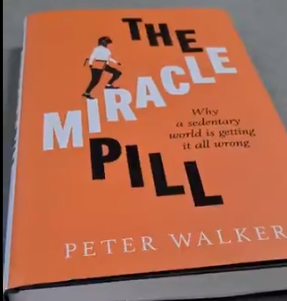
Review. Peter Walker: “The Miracle Pill”

The titles of Peter Walker’s books indicate that he thinks he has got big solutions to big problems. I said in my review of his first, How Cycling Can Save the Worldr/ that: “Those of us with a cynical mindset might be put off by such optimism and the extravagant claim of the title. But don’t be…”

So how about “The Miracle Pill”? Yet again Walker has addressed a massive problem – the quite enormous health disbenefits of not being physically active and presented solutions to it. Anybody interested in what is now called “Active Travel” (walking and cycling as forms of everyday transport) should read it.

Continue reading

“ Reducing Road Danger: Empowering Local Communities”.

We’re delighted that our Conference (jointly organised with RoadPeace) which was due to be held in April, will now happen as two webinars on October 22nd and 29th at 4 pm:

 “ Reducing Road Danger: Empowering Local Communities”.

Do register (for free) here https://t.co/hfeDTpGLaS?amp=1  as soon as possible.

  •  

October 22nd – speakers

  • Welcome – Baroness Jones, President, Road Danger Reduction Forum
  • Vision Zero: Enforcement and reducing road danger” (including using 3rd party reporting) Andy Cox, formerly Superintendent, Metropolitan Police Roads and Traffic Police.
  • How important is dashcam footage when a crash happens?” Ciara Lee, RoadPeace.
  • USING THE TECHNOLOGY-
  • Madison/Cycliq bike camera lights
  • Nextbase Dashcams
  • “Cycling Mikey“
  • October 29th – speakers
  • Welcome – Baroness Jones, President, Road Danger Reduction Forum
  • Reducing speeds in your neighbourhood – 20mph speed limits, Intelligent Speed Assistance (ISA) and Community RoadwatchJeremy Leach, Action Vision Zero.
  • Low Traffic Neighbourhoods: Winning over the local community”: Clare Rogers, London Cycling Campaign.
  • Involving your Police and Crime CommissionerVictoria Lebrec, RoadPeace.
  • PANEL DISCUSSION: Including Dr Robert Davis, Chair RDRF

SPONSORS:

Moore Barlow

Madison UK for CYCLIQ

Nextbase Uk Dashcams

The two webinars can be seen here :

Webinar 2

Webinar 1

“Reducing Road Danger: Empowering Local Communities”

We’re pleased that our conference, jointly organised with our friends RoadPeace, planned for April will now be run as two webinars on October 22nd and 29th starting at 4 pm.

Please register for free here https://www.eventbrite.com/e/reducing-road-danger-empowering-local-communities-tickets-123531503051 as soon as possible.

PROGRAMME:

October 22nd – speakers

•Welcome – Baroness Jones , President, Road Danger Reduction Forum

•”Vision Zero: Enforcement and reducing road danger” (including using 3rd party reporting)Andy Cox, formerly Superintendent, Metropolitan Police Roads and Traffic Police

•”How important is dashcam footage when a crash happens?” Ciara Lee, RoadPeace.

•”Using the technology” –

Madison/Cycliq bike camera lights

Nextbase Dashcams

“Cycling Mikey“

• •October 29th – speakers

•Welcome – Baroness Jones President, Road Danger Reduction Forum

•”Reducing speeds in your neighbourhood – 20mph speed limits, Intelligent Speed Assistance (ISA) and Community RoadwatchJeremy Leach, Action Vision Zero

•“Low Traffic Neighbourhoods: Winning over the local community”: Clare Rogers, London Cycling Campaign

•“Involving your Police and Crime CommissionerVictoria Lebrec, RoadPeace

• Panel discussion with speakers and Dr Robert Davis, Chair RDRF

June 3rd 2020 – Crunch time for Active/Sustainable Travel in the UK

This is the latest update on my post  here on Transport in the time of the COVID-19 crisis. The previous update can be seen here. Below is a version of my presentation which you can see from 1.42 on You Tube here

This may seem dramatic, but we are now seeing the best – and only – window of opportunity for sustainable/active travel in the UK to really advance during the last few decades. As explained below, this is dependent onlocal authorities in the UK properly providing for walking and cycling in accordance with Government requirements. There is a lot of work to be done in persuading many that this really has to be done – for air quality, congestion reduction, any serious prospect of addressing climate change, public health and the local environment.

Continue reading