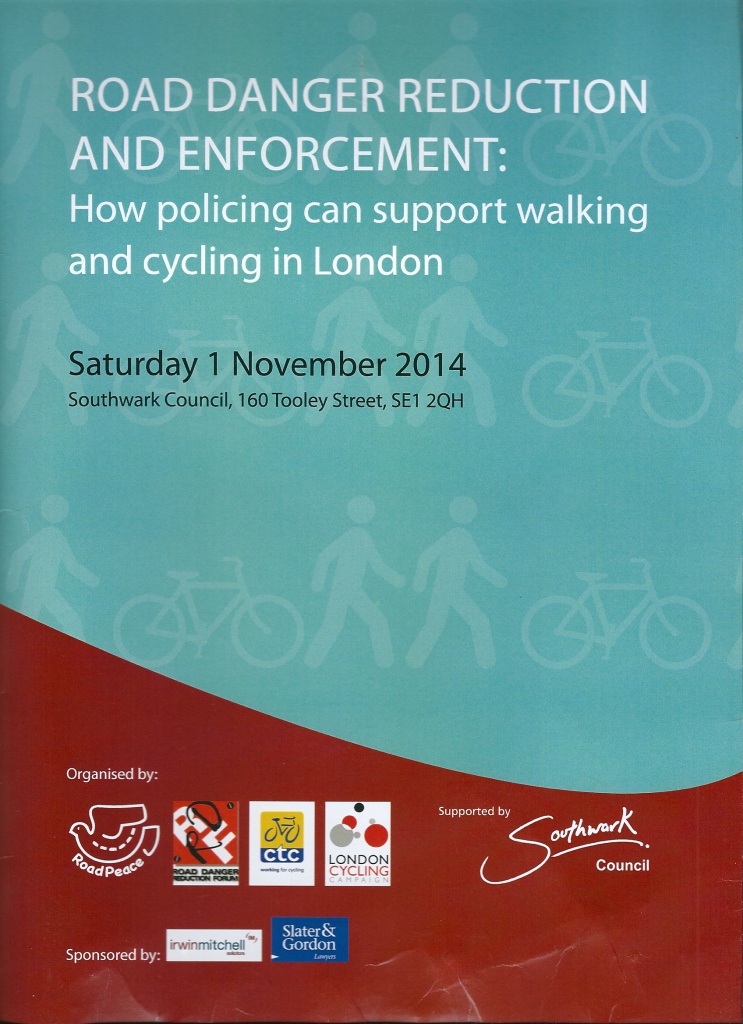
This report summarises the talks and comments from the audience at the first of our annual conferences on Road Danger Reduction and Enforcement, with presentations and hand outs here
Earlier this year the RDRF responded to Transport for London’s Draft Cycle Safety Action Plan (CSAP) here and here .
I argued then that: “The draft CSAP is a fundamentally flawed document which fails in three main respects. Firstly, its idea of “safety” for cyclists is measured in a way which can indicate that having fewer cyclists and a higher cyclist casualty rate is BETTER than having more cyclists and a lower casualty rate. Secondly, it fails to differentiate between measures which reduce danger to cyclists (and other road users) and those which do not. Thirdly, it has no real way of assessing the effects of measures implemented.”
The new CSAP is now out . Apart from some typographical differences, there are only two noticeable changes. One of these changes seems to be simply cosmetic, the other could potentially have an effect, but I suggest is unlikely to. (So much for the effects of consultation). I discuss these changes below along with general comments: if these seem the same as before it’s because (apart from the two changes) the criticisms remain the same. So: Continue reading



A one-day conference ‘Road Danger Reduction and Enforcement: How policing can support walking and cycling in London’
Organised by RoadPeace, the national charity for road crash victims; the Road Danger Reduction Forum; CTC, the national cycling charity; and the London Cycling Campaign, the conference will highlight what the Metropolitan Police Service and Transport for London are doing to improve cyclist and pedestrian safety, and what changes campaigners would like to see. The conference is aimed at non-professional road safety campaigners, Councillors, and transport, health and road safety professionals concerned with safety on the roads.
The conference will be chaired jointly by Lord Berkeley, President of the Road Danger Reduction Forum and Vice-President of CTC, and Baroness Jenny Jones MLA.
The conference, which is free of charge, will be hosted by LB Southwark at 160 Tooley Street (http://www.southwark.gov.uk/location) on:
To register for the conference go to https://www.eventbrite.com/e/traffic-law-enforcement-conference-tickets-13438006439
Lord Berkeley says: “Attention is rightly directed at how our streets are engineered for people walking and cycling. But we also need to have road traffic law properly enforced – for the safety of all road users – if we are to reduce danger to cyclists and pedestrians.”
The conference has been welcomed by the 20’s plenty campaign and the Transport and Health Study Group. Conference programme is below here: Continue reading
This is our response to the draft Cycle Safety Action Plan issued by Transport for London, which you can respond to here by Thursday July 25th .
The draft CSAP is a fundamentally flawed document which fails in three main respects. Firstly, its idea of “safety” for cyclists is measured in a way which can indicate that having fewer cyclists and a higher cyclist casualty rate is BETTER than having more cyclists and a lower casualty rate. Secondly, it fails to differentiate between measures which reduce danger to cyclists (and other road users) and those which do not. Thirdly, it has no real way of assessing the effects of measures implemented. Continue reading
We raised our concerns about the widespread (mis)use of “Cyclists stay back” stickers over 6 months ago , sent a letter of complaint with our colleagues the CTC (the National Cyclists’ Charity), the London Cycling Campaign, RoadPeace, and the Association of Bikeability Schemes, followed by another complaint due to an inadequate response by TfL . And then TfL chose to give yet another – let’s say “inadequate” again because we try to be polite – reply to press enquiries rather than replying to us directly. By now, even seasoned campaigners were getting annoyed.
But yesterday RDRF and the other organisations involved, plus representatives of the London Boroughs Cycling Officers Group, attended a meeting at Transport for London chaired by Lilli Matson, Head of Strategy and Outcome Planning, with nine other TfL officers concerned with safety, freight and fleet operations, buses, taxis, and marketing and communications. We are glad to say that the outcome was very positive. Continue reading
Although the image below is a bit difficult to make out (the original is here), we reproduce it and take some time to examine its message as delivered by the “South Yorkshire Safer Roads Partnership” (SYSRP) . It is typical of why official “road safety” – as opposed to the real road safety of road danger reduction – is part of the problem of danger on the roads and discrimination against cycling and sustainable transport.

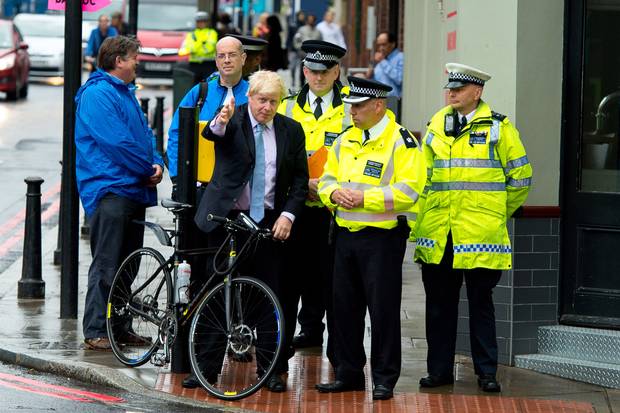 Mayor Johnson at launch of “mini-Operation Safeways” (Photo: Evening Standard)
Yesterday Mayor Johnson announced a reprise of last winter’s “Operation Safeway” with claims that this policing programme will increase cyclist safety. We are very much in favour of law enforcement as a crucial element in reducing danger for cyclists and other road users – but we doubt that the “mini- Operation Safeways” announced will be it. Unless the lessons from Operation Safeway are learned – and there is no sign that they have been – TfL and MPS will continue to fail Londoners by not providing non-discriminatory and effective law enforcement. Here’s why: Continue reading
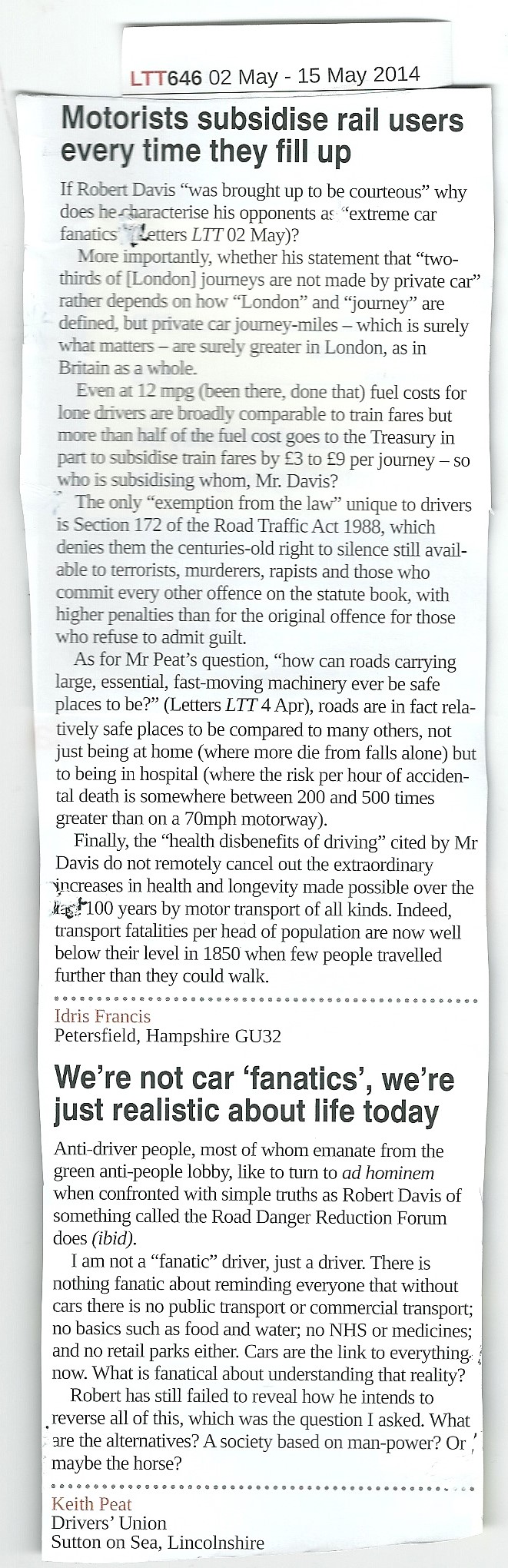
My latest contribution to a continuing debate in Local Transport Today (see my last letter) comes in response to letters from two (I think) extreme advocates of motorisation in issue 646 here*:
My response is in issue 647 as published below:
 Road Danger Reduction Forum