Let’s look at the rest of TfL’s “Towards a Road Safety Action Plan for London: 2020” It is basically the usual confusions, distortions and misguided mythology of “road safety” ideology. We have outlined some of the typical problems here, and, as always, suggest a look at: John Adams’ “Risk and Freedom: the record of road safety regulation” and a short discussion in his “Managing transport risks: what works?” Let’s consider some of the points made in the TfL document: Continue reading
Category Archives: HGVs
Campaign season for cyclists’ safety: “See Me Save Me” and the blind spot question

“BLIND SPOT”:
OXFORD ENGLISH DICTIONARY: an area in which a person lacks understanding or impartiality; COLLINS: a subject about which a person is ignorant or prejudiced, or an occupation in which he is inefficient
We are pleased to support “See Me Save Me”. It is an organisation entrenched in the road danger reduction approach : and as such committed to reducing danger from lorries – towards pedestrians as well as cyclists – at source. We believe that doing this will require examining what exactly is meant by a “blind spot”. This not so much a question of technical fixes, but like all questions of safety on the road, about the power of some road users to endanger others. Continue reading
Campaign season for the safety of cyclists – we have been here before

Lynda Chalker
Photo: Victor Patterson
As we approach the 27th anniversary of one of the first “road safety” conferences I ever attended, “Ways to safer cycling” , I recall the words of the key speaker there: Minister of State, Lynda Chalker: “To the “Three Es” of road safety: Engineering, Education and Enforcement, we should add a fourth “E” – Encouragement – we should be encouraging cycling”. It serves as an introduction to a progress report on current campaigning for cyclists’ safety.
In some ways, we have moved forward since 1985. At the same conference I also remember the words of the Chairman, Lord Nugent of the Royal Society for the Prevention of Accidents (RoSPA), to the effect that the onus of responsibility was on cyclists when it came to cyclists’ safety , because “You’re the ones who are vulnerable”. These words seemed to upset the Department of Transport minders: he was off message then, and you wouldn’t get away with it now. Also, the notorious words of the Chief Engineer from Cambridge City Council: “If you are thinking of cycling in a modern city: don’t”. You wouldn’t get away with that either.
But how much has actually changed? Continue reading
Campaign season for the safety of cyclists – but will they do any good? Part Two – The Times
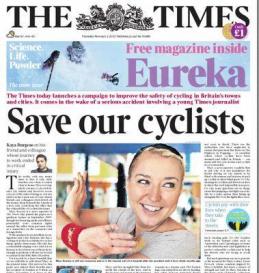
The devotion of a whole front page by The Times to cyclist safety is quite extraordinary. RDRF has, along with other organisations and 17,000 individuals as of the first draft of this post on 5th February signed up to it. But will this campaign fizzle out like the ones waged by The Independent and the London Evening Standard – let alone safety campaigns launched throughout the last century? At the risk of seeming overly negative, we have to question features of this campaign and ask what will be required to effectively pursue the good intentions that exist.
After all, “safety on the road” can mean all kinds of things: from misguided and counterproductive fantasies through to getting the most vulnerable out of the way of the most dangerous. Public figures have signed up to The Times campaign – as they would to motherhood and apple pie. Below we analyse the campaign in detail: its potential for reducing danger on the road to cyclists and other road users, what will be required to pursue these objectives – and the problems that have already surfaced. Continue reading
"Death on the Streets: cars and the mythology of road safety"
This book, one of the main sources of evidence for the road danger reduction approach, is now out of print. A few copies are available from the author. Here are what reviewers have said: Continue reading
The London Cycling Campaign and what cyclists in London want


The continuing saga of Blackfriars Bridge has revealed a more high profile and combative London Cycling Campaign, preparing a new strategy for the organisation the year before the Mayoral elections. Will this be the way towards getting “the cyclised City”?
Consider LCC CEO Ashok Sinha’s approach as described in London Cyclist June-July 2011 (pp.16 – 18). Having stated that London is indisputably not a cyclised city, and not on a trajectory towards becoming one, how are we to remedy the situation (an issue we have addressed before here , here , and here ? The answer for him is “everything” Continue reading
 Road Danger Reduction Forum