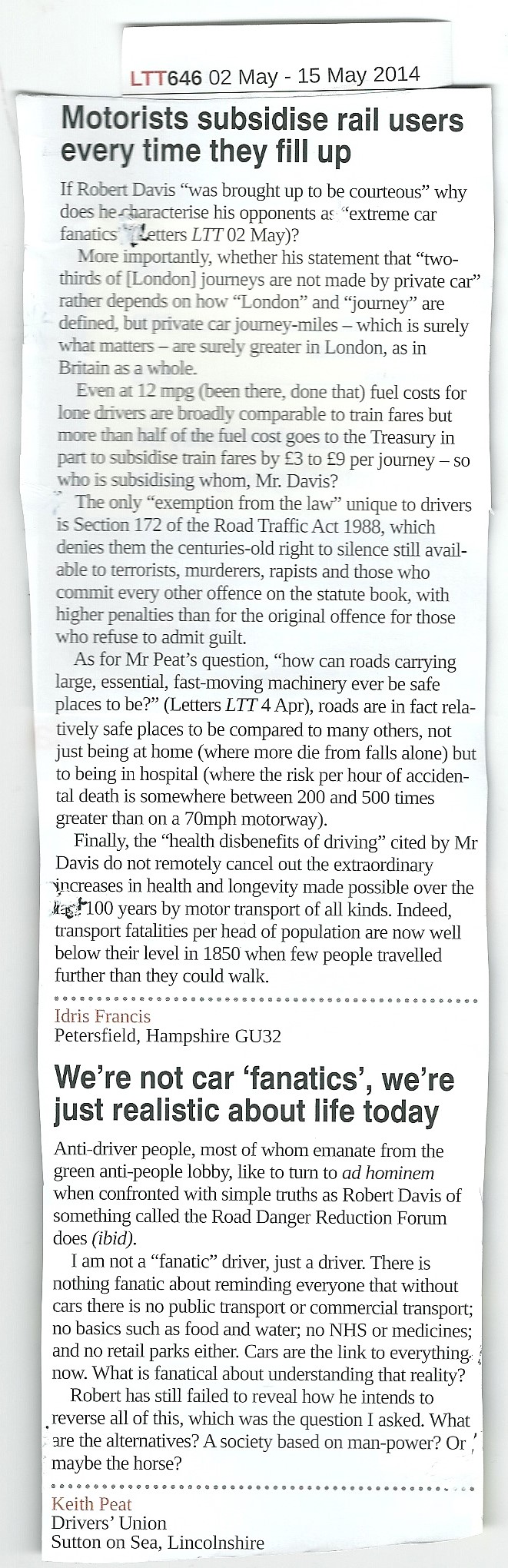
My latest contribution to a continuing debate in Local Transport Today (see my last letter) comes in response to letters from two (I think) extreme advocates of motorisation in issue 646 here*:
My response is in issue 647 as published below:
My latest contribution to a continuing debate in Local Transport Today (see my last letter) comes in response to letters from two (I think) extreme advocates of motorisation in issue 646 here*:
My response is in issue 647 as published below:
In response to my letter in Local Tansport Today 643 , LTT published a letter (issue 644) from a particularly extreme motoring advocate. (SEE TEXT OF LETTER BELOW) I politely responded as follows: Continue reading
We have discussed this giveaway before, but it appears that we underestimated the extent of this additional subsidy to motoring. What makes it worse is the justification for this policy given by the Treasury (and HMRC) this week: “Analysis of the dynamic effects of fuel duty reductions”
This policy has been appalling for the prospects of sustainable transport in Britain. I list problems with the report below: Continue reading
Something didn’t happen in the wake of the Budget. There was practically no media response to the Chancellor’s continued refusal, yet again, to increase fuel tax duty. Below we put this in the context of continued discrimination against sustainable transport modes and support for a more car-based transport system, as well as showing how the costs of motoring stand in stark contrast to other expenditure. Continue reading
 Photo: Daily Telegraph
We borrow the phrase from the CPRE campaign and its opposition to the National Networks National Policy Statement which is out to consultation. CPRE have a helpful page for those of you (like , regrettably, us) who have let this one slip by. Essentially the NNNP statement is based on Department for Transport thinking which we commented on last year. Below is what we sent in – do try and send in a reply by the end of 26th February 2014. Continue reading

Following the initial concerns raised on our website before Xmas 2013, the Road Danger Reduction Forum has come together with other organisations to explain our concerns to, and ask for action from, Transport for London. Along with the RDRF they are the London Cycling Campaign; CTC: the national cycling charity; RoadPeace: the national charity for road crash victims; and TABS: the Association of Bikeability Schemes:
The organisations that have signed this document have agreed the following statements about stickers aimed at cyclists on the rear of commercial vehicles in London. Continue reading

Halfords, as well as being a large car parts and servicing business, is a major cycle retail business and operates a “Cycle to Work” government approved initiative to enable employees to use a bike and accessories to cycle to work. We think the extract from their “cycle2work” leaflet sends out the wrong message about cycling. Here’s why: Continue reading
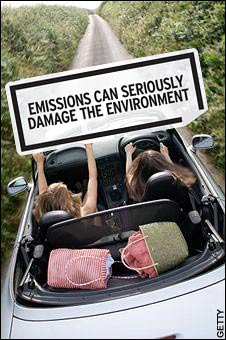
Health warnings on car ads?
The ASA has now changed it’s mind on this matter . Hopefully partly as a result of the information contained in the protests to it from organisations and individuals like ours.
First, the good news. The idiotic ruling of the ASA described here has been withdrawn following a veritable storm of protest. It is good to see that a diverse (and normally often disunited) community of cyclists and others concerned about a civilised approach to cycling and safety on the road can swiftly summon up good quality arguments and have an effect.
But this is just the start. This matter is far from being resolved, and it may well be that the outcome is a quite unsatisfactory judgement about the portrayal of cycling. We need to examine the issues regarding ASA judgements on matters of safety on the road in more detail. Continue reading

The ASA has now changed it’s mind on this matter . Hopefully partly as a result of the information contained in the protests to it from organisations and individuals like ours. (See also our next post)
A piece of idiocy by the ASA has caused justified anger among cycling groups and others concerned with a civilised approach to danger on the road.
You can read about it here; here; here and also here the CTC’s comments are here:
The RDRF objects to the ASA’s decision on the basis that: Continue reading
Our post on the effects of the NZ cycle helmet law has had more views than any other so far on www.rdrf.org.uk . Prompted by this, below we:
(i) Give fuller references to the evidence.
(ii) Suggest the reason for the observed changes (particularly the apparent adverse effects on cyclist casualty rates).
(iii) Look at helmet advocacy in the context of a car dominated “road safety” culture.
 Road Danger Reduction Forum