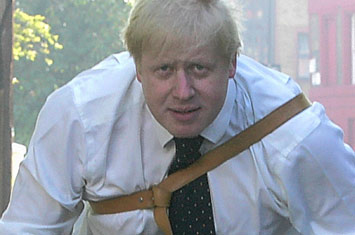
Boris and the ass question: Part Two – cycle super highways

  Discussing what is or should be a “cycle route” is one of the more tedious (but necessary)  parts of considering cycling as a mode of transport). All roads except motorways can be seen as “cycle routes”: if you want to use a bicycle to get from where you live to where you need to go, you have to use the public highway.

 That said, there is a plausible case for engineering the highway to reduce danger and inconvenience for cyclists, so there is a need for engineering at particular dangerous or inconvenient locations for cyclists like large gyratory systems. Or a network of signed cycle routes. Or both. In fact, it is arguable that without doing anything special “for cyclists”, all roads should have danger to cyclists engineered out of them as much as possible as a matter of course.

 So what has happened in London? Continue reading

Boris and the ass question

boris-bike-355x235  

 Following the unveiling of the first “Cycling Super Highway” (CSH) in London by Mayor Boris Johnson, the excellent Velorution website declared “Boris is an Asshttp://www.velorution.biz/2010/05/boris-is-an-ass/. . Well, reducing politics to personalities and epithets is not our style.

 Also, we would point out that:

  • Mayor Johnson has done a great service to cycling by cycling daily in normal office clothes (see above): a good example to London commuters.
  •  He says the right things about cycling: “Put simply, it’s the best way to get around our city, and arguably the single most important tool for making London the best big city in the world.” (Cycling Revolution in London, TfL,  May 2010)
  • Any problems with officialdom’s treatment of cycling can often be traced back to other agencies and Transport for London/ Greater London Authority under Boris’ predecessor, Ken Livingstone.

Below we review what has been happening in London since Transport for London came into being. The issue is, when the Mayor, GLA and TfL tell us about their apparently wonderful plans for cycling, are we asses to believe them? Continue reading

A very moderate suggestion

Here at RDRF we break taboos.

We point out that people adapt to perceptions of risk. We suggest that it is not necessarily a very good idea to assume that we should be living in a world with more and more cars which are to be used more. We think that danger should primarily be thought of in terms of the threat one poses to others, rather than the (supposed) danger presented to you. We try to speak English rather than “roadsafetyese”.

 It’s a bit like the old idea that “you can’t tell a man he’s not a good a driver”. We’re the kind of people who do.

 So, as we enter 2010 and all face the prospect of higher taxes and/or public service cuts, not to mention later retirement, reduced savings etc., let’s look at one particular taboo area which is even more relevant now than during the boom years. It’s also an idea which has a very special relevance for transport professionals.

 After all, this is the time when transport practitioners working in areas financed by central or local government are bracing ourselves for the dreaded cuts. How will we cope? Is there anything we can do to soften the blow(s)?

 I – and this is a personal opinion – think there is. It is for transport professionals to put forward the facts about the costs of motoring and present Government with an alternative to some of the inevitable cuts and taxation rises, not least in the area of properly resourcing sustainable transport. (I’m not interested in cuts in road building projects – a good area for public expenditure cuts if ever there was one).

 That alternative is one which has always been on the cards for sustainable transport advocates, which was minimally recognised with the fuel tax accelerator, but which has always been something of a taboo subject for politicians and professionals alike.  So here goes – steel yourselves:

 I think that motorists should pay a reasonable amount of money to drive their vehicles on the public highway.

 Phew! If you’re still breathing, let me explain what this would mean, why it is justified – and why it could, despite all the conventional wisdom, be a lot more widely accepted than most people think.

Continue reading

What "treachery" of snow and ice?

This might surprise you, particularly as we read of collisons involving road users on icy roads. And for those who will really have to travel by road, yes, we sympathise.


But I submit that the word “treacherous” employed to describe difficult conditions is misplaced – and looking at this (ab)use of language tells us a lot about travel on the road, and not just the safety of it. For us at RDRF, speaking English, rather than “road safetyese” is very important. “Treachery” in  the current discussion implies an immutable right to drive as far as is desired, when, how and for whatever reason – and that if the environment does not allow you to do that with convenience and safety, it has “betrayed” you.


For a superb discussion of how a hypermobile, car-based society views the weather conditions that are an inevitable fact of life, we suggest you read Simon Jenkins in the Guardian on http://www.guardian.co.uk/commentisfree/2009/dec/22/blame-for-winter-travel-chaos  Continue reading

Let's get rid of "the vulnerable road user"

By which I mean, of course, the term “vulnerable road user”…

  Mae-West-569x768-77kb-media-882-media-85070-1068107101

“Men are always trying to protect me, I wonder what they are trying to protect me from…”. Mae West

A lot of colleagues think that it is helpful to refer to pedestrians (particularly children and elderly people) and cyclists as “vulnerable road users”. I disagree: seeing people who just happen to be outside metal boxes as being special easily morphs into seeing us AS A PROBLEM.  It is often connected to what has been referred to as the “Fear of Cycling”. It misses out on the elephant in the room – or what the excellent Mikael Coville-Anderson of Copenahgenize.com refers to as “The Bull in the China Shop”. Continue reading

Oh no, not seat belts again…

You might think that discussion about compulsory front seat belt legislation in the U K (introduced 26 years ago and confirmed 3 years later) is about the last thing that those of us interested in safety on the road should be considering at the moment.

Surely there is no need for detailed statistical discussion about this event, still less questioning what has become a – or the – major triumph for those officially charged with safety on the road?

But no. A recent debate has seen the proponents of compulsory bicycle helmet use drag the issue out again – and this time some revealing facts have been shown up. Some uncomfortable truths about the effects of the seat belt law in the UK  and the  “road safety” establishment  have critical relevance to everything that those of us working for safety of all road users should be aware of.

So, if you’re interested in real road safety, do read on… Continue reading

"A Safer (sic) Way: Making Britain’s Roads the Safest (sic) in the World"

The Department for Transport has produced a crucial document:  “A Safer Way: Making Britain’s Roads the Safest in the World”  which will be the basis of future national “road safety” policy after 2010. Our response to the consultation document is here: the DfT have also kindly allowed us to post the document (with our comments inserted in the text) on our site here.

As this document is of such central importance, it is important to be aware of it. For us, there is one significant move in the right direction (the adoption of the “rate-based” target for cyclists and pedestrians); one or two other minor improvements; a few things we are more or less sympathetic too – and the rest is the same old, er, same old. (Who says we can’t be polite?). We are basically opposed to a fundamentally flawed approach to understanding what danger on the road is – and what to do about it – throughout “A Safer Way”, specifically, the continued:

* Failure to properly define “safe roads” (allowing, for example, more hazardous environments to be defined as “safer”).

* Denial of adaptive behaviour (risk compensation) by road users.

* Inability or refusal to differentiate between endangering or killing/hurting  others on the one hand, and being endangered or killed/hurt on the other.

* Failure to approach the standards of other relevant safety regimes and oppose rule and law breaking driver behaviour.

* Commitment towards unsustainable transport policy and car dependence.

In fact, it shows just how far away government is from grasping what road safety policy should be about, and why the RDRF is needed. So do have a read of it and our response.