Category Archives: Cycling
Bicycle Politics Conference at Lancaster University
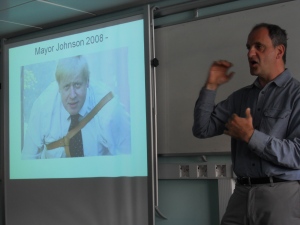
RDRF Chair Dr. Robert Davis was privileged to give not just one but two papers at this conference hosted by Drs. Dave Horton and Aurora Pereira-Trujillo at the Centre for Mobilities Research last month. One was on the general principles of Road Danger Reduction, the other on cycling in London (see photo above: I’m the one doing something funny with his hands, I can’t remember what). For a report go to http://thinkingaboutcycling.wordpress.com/2010/10/01/bicycle-politics-workshop-report/ and while you’re there, take a look at Dave Horton’s blog “Thinking about Cycling” http://thinkingaboutcycling.wordpress.com/, particularly the excellent article “Fear of Cycling”.
RD 2nd October 2010
A revealing issue
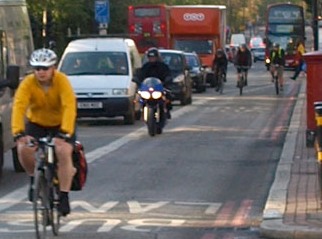
Previous posts have described the record of Transport for London and the Greater London Authority under Mayors Livingstone and Johnson with regard to cycling. Whatever the verdict on this record is, there is one two-wheeler group that has done well in London since 2000 – motorcyclists. Motorcyclists have profited from virtually unhindered access to supposedly cycle-specific facilties such as Advanced Stop Lines and cycle gaps in road closures. Press attention is drawn to pedestrians killed in collisons with cyclists, but not the larger number in incidents involving motorcyclists. While cycling is persistently portrayed as hazardous, motorcycling – with far higher casualty rates – is not.
TfL’s pro-motorcycling agenda is shown up well in the saga of allowing motorcyclists into bus lanes. While the details may tend to bore all but the most hardened transport professional, this episode tells us a lot about how some road user groups can get their way, irrespective of the evidence supposedly required to justify legal changes. Time and again we can see in the history “road safety” how a safety benefit is consumed as a performance benefit. In this case it is even dubious whether any safety benefit for the measure taken has ever existed: we simply move to the performance benefit (of motorcyclists having extra road space) while using “road safety” as a justification.
Below Colin McKenzie summarises the latest stage in this story: Continue reading
Boris and the ass question: Part Three: Where's the money?
 There’s no doubt that cycling is increasing in London – but whether this has much to do with the activities of Transport for London (TfL) is open to doubt. More importantly: will the actions of Mayor Johnson, TfL and the GLA stand a chance of achieving his (modest) targets? Continue reading
Boris and the ass question
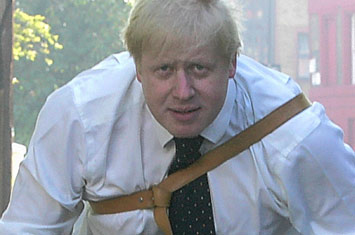
Following the unveiling of the first “Cycling Super Highway” (CSH) in London by Mayor Boris Johnson, the excellent Velorution website declared “Boris is an Ass” http://www.velorution.biz/2010/05/boris-is-an-ass/. . Well, reducing politics to personalities and epithets is not our style.
Also, we would point out that:
- Mayor Johnson has done a great service to cycling by cycling daily in normal office clothes (see above): a good example to London commuters.
- He says the right things about cycling: “Put simply, it’s the best way to get around our city, and arguably the single most important tool for making London the best big city in the world.” (Cycling Revolution in London, TfL, May 2010)
- Any problems with officialdom’s treatment of cycling can often be traced back to other agencies and Transport for London/ Greater London Authority under Boris’ predecessor, Ken Livingstone.
Below we review what has been happening in London since Transport for London came into being. The issue is, when the Mayor, GLA and TfL tell us about their apparently wonderful plans for cycling, are we asses to believe them? Continue reading
A very moderate suggestion
Here at RDRF we break taboos.
We point out that people adapt to perceptions of risk. We suggest that it is not necessarily a very good idea to assume that we should be living in a world with more and more cars which are to be used more. We think that danger should primarily be thought of in terms of the threat one poses to others, rather than the (supposed) danger presented to you. We try to speak English rather than “roadsafetyese”.
It’s a bit like the old idea that “you can’t tell a man he’s not a good a driver”. We’re the kind of people who do.
So, as we enter 2010 and all face the prospect of higher taxes and/or public service cuts, not to mention later retirement, reduced savings etc., let’s look at one particular taboo area which is even more relevant now than during the boom years. It’s also an idea which has a very special relevance for transport professionals.
After all, this is the time when transport practitioners working in areas financed by central or local government are bracing ourselves for the dreaded cuts. How will we cope? Is there anything we can do to soften the blow(s)?
I – and this is a personal opinion – think there is. It is for transport professionals to put forward the facts about the costs of motoring and present Government with an alternative to some of the inevitable cuts and taxation rises, not least in the area of properly resourcing sustainable transport. (I’m not interested in cuts in road building projects – a good area for public expenditure cuts if ever there was one).
That alternative is one which has always been on the cards for sustainable transport advocates, which was minimally recognised with the fuel tax accelerator, but which has always been something of a taboo subject for politicians and professionals alike. So here goes – steel yourselves:
I think that motorists should pay a reasonable amount of money to drive their vehicles on the public highway.
Phew! If you’re still breathing, let me explain what this would mean, why it is justified – and why it could, despite all the conventional wisdom, be a lot more widely accepted than most people think.
Let's get rid of "the vulnerable road user"
By which I mean, of course, the term “vulnerable road user”…

“Men are always trying to protect me, I wonder what they are trying to protect me from…”. Mae West
A lot of colleagues think that it is helpful to refer to pedestrians (particularly children and elderly people) and cyclists as “vulnerable road users”. I disagree: seeing people who just happen to be outside metal boxes as being special easily morphs into seeing us AS A PROBLEM. It is often connected to what has been referred to as the “Fear of Cycling”. It misses out on the elephant in the room – or what the excellent Mikael Coville-Anderson of Copenahgenize.com refers to as “The Bull in the China Shop”. Continue reading
Oh no, not seat belts again…
You might think that discussion about compulsory front seat belt legislation in the U K (introduced 26 years ago and confirmed 3 years later) is about the last thing that those of us interested in safety on the road should be considering at the moment.
Surely there is no need for detailed statistical discussion about this event, still less questioning what has become a – or the – major triumph for those officially charged with safety on the road?
But no. A recent debate has seen the proponents of compulsory bicycle helmet use drag the issue out again – and this time some revealing facts have been shown up. Some uncomfortable truths about the effects of the seat belt law in the UK and the “road safety” establishment have critical relevance to everything that those of us working for safety of all road users should be aware of.
So, if you’re interested in real road safety, do read on… Continue reading
 Road Danger Reduction Forum