Bradley Wiggins has (partly) backtracked on his comments made on August 1st. However, there is no fundamental change in the key ideological elements which were present in his original statement. They tell us a lot about the cultural barriers to achieving safety for cyclists and other road users. Continue reading
Why Bradley Wiggins is so wrong: Part One: Sport, Transport and Role Models
Firstly, the nice part: the history I share with Britain’s best ever racing cyclist. And then why I appeared on Thursday’s Sky News to explain why what he said the day before was so wrong. Continue reading
Car culture has suffocated the global warming agenda

The following letter written by RDRF Chair Dr. Robert Davis was published in thecurrent issue of Local Transport Today: Continue reading
Another conference – and why getting the numbers right is important
Forgive us for highlighting what should be a rather obvious statistical mistake. However, it reveals, yet again, an underlying mind-set which has seriously negative implications for real road safety and sustainable transport policy. Hopefully this matter will be raised at the forthcoming “Cycle Summit 2012” . Continue reading
MAYOR JOHNSON – Getting the numbers wrong
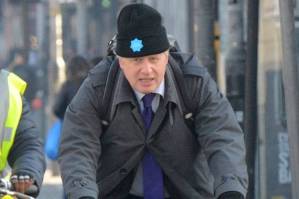
There has been justified anger at the absurd – and dangerous – claim by Mayor Johnson that: “I’ve seen a figure, I think, of 62%, which
is the high proportion of cycling KSIs (killed or seriously injured) that are associated with some infraction by the cyclists themselves of the rules of the
road.” This has been jumped on with a review of the available evidence showing how wrong this statement is by the CTC . The London Cycling Campaign have also demanded to know the
origins of these supposed “statistics” in a splendid corrective . Ths reaction to Mayor Johnson’s gaffe here is excellent: but there is more to comment on in this case. Continue reading
What do they have in common?
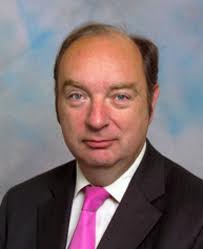

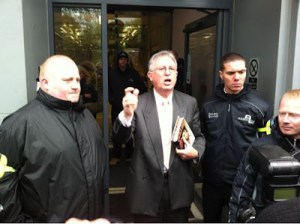
Photos: Norman Baker MP; Mike Pennington MP; Addison Lee’s Mr Griffin with staff: (DfT; Daily Telegraph; Cyclists in the City)
Above are the two Government Ministers responsible for cycling and road safety and the Chairman of Addison Lee (with members of his staff). They all claim to be concerned for the safety of cyclists: indeed all have signed up to The Times campaign.
It may seem unfair to link the author of a tirade against cyclists with elected politicians nominally committed to supporting cycling. But I think it is there. Essentially all three start off with assumption that cyclists are “vulnerable road users” – so-called because they are outside motor vehicles when travelling, as is most of humanity – and are a problem because of this. Continue reading
One way that Government Ministers disciminate against more and safer cycling
It’s been a ludicrously busy time for those concerned with cyclists’ safety. First it was the campaigns of The Times and others, kicking off parliamentary debates and protest rides; then the Mayoral elections, followed up by the Addison Lee episode.
But then we get another resounding clang against any kind of civilised approach to real safety on the road for cyclists (and others). Yes, it’s the words of the two minsters responsible for the safety of cyclists – no less. This has led various commentators to parade their gob-smackedness, including “Minister for road safety loses his marbles live on parliamentary TV” from the normally restrained Carlton Reid . But actually there is nothing new here. From the point of view of traditional “road safety” ideology, this is completely rational and no marbles have been lost at all.
What we have seen in their estimation of levels of “cyclists’ safety” is a grotesque inversion of reality. And this is not just a technical issue about measurement: in turning the truth on its head they place yet another obstacle in the path of achieving cyclists’ safety. Continue reading
Why the Addison Lee saga is important
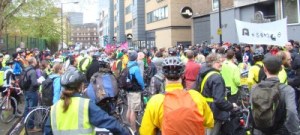
- Cyclists protest outside Addison Lee HQ: (Photo: Big Smoke)
While off the air, a major story broke: RDRF responded and was quoted in The Times and various blogs .A version of another e-mail was posted by our friends at Movement for Liveable London . Here is an updated version of it: Continue reading
Please bear with us…
As you may have noticed, the Road Danger Reduction Forum website was hacked into and compromised a few days ago. We are getting it back together and hope to return shortly with a more secure and better site – please bear with us while we do! UPDATE: 27th April: Our site is being revamped and normal service is beingr esuled..Don’t forget the Big Bike Ride in London on April 28th (or its Edinburgh equivalent)
Campaign season for cyclists’ safety: “See Me Save Me” and the blind spot question

“BLIND SPOT”:
OXFORD ENGLISH DICTIONARY: an area in which a person lacks understanding or impartiality; COLLINS: a subject about which a person is ignorant or prejudiced, or an occupation in which he is inefficient
We are pleased to support “See Me Save Me”. It is an organisation entrenched in the road danger reduction approach : and as such committed to reducing danger from lorries – towards pedestrians as well as cyclists – at source. We believe that doing this will require examining what exactly is meant by a “blind spot”. This not so much a question of technical fixes, but like all questions of safety on the road, about the power of some road users to endanger others. Continue reading
 Road Danger Reduction Forum