Category Archives: “Road Safety”

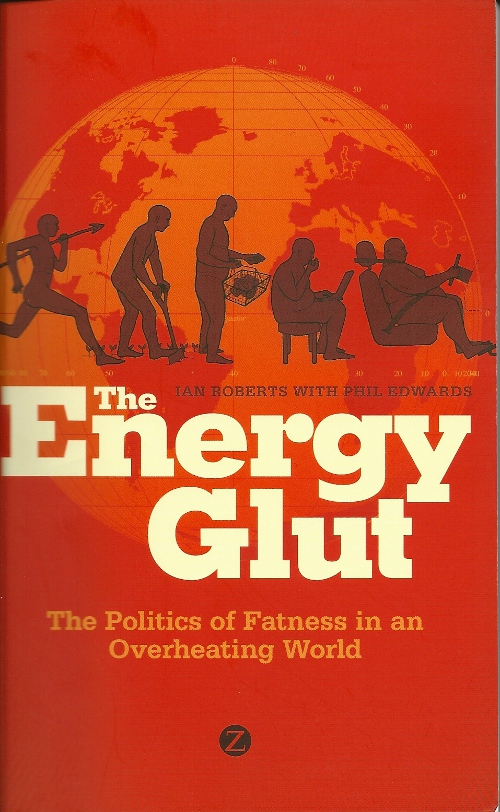
Read this book!


At the founding of the RDRF in Leeds in 1993 we were confronted with the issue of, well, what would our name be? Would anybody understand or use the phrase Road Danger Reduction? I think we can give ourselves a pat on the back: RDR has been formally endorsed by (among others) the CTC (National cyclists’ organisation), London Cycling Campaign, RoadPeace, Living Streets, Twenty’s Plenty, the Environmental Transport Association, and the Road Danger Reduction Charter signed up to (if not actively pursued) by a number of local authorities. Of course, getting the approach understood – differentiating us from “road safety” and publicising the sustainable transport agenda – is another issue from getting it accepted by the powers that be.  After the Comprehensive Spending Review, it looks like we’re going backwards – or at least not forwards…

But now the good news: if we can’t actually get the RDR programme on the official agenda, we have got a forceful endorsement of RDR in this superb book: “Real road safety means reducing road danger, which implies far fewer motor vehicles travelling at much lower speeds” (p.84) and, on the twinned themes of the book:” The only practicable response to climate change and population weight gain is that walking and cycling are re-established as the predominant modes of urban transportation“(p.119).

Epidemiologist Professor Ian Roberts of the London School of Hygiene and Tropical Medicine is well known to us for his work on the effects of 20 mph zones and his critique of  the pressure for road building from the global “road safety”/car industry lobby in developing countries. As with his previous work, the links between different parts of the effects of mass motorisation are established. Except it is not just the two main themes of the health disbenefits of mass car use and the greenhouse gas emissions from motor vehicles, but road danger, the effects on local community, and dependence on oil. On top of this, obesity and global warming are shown to be linked more intricately and deeply than we might have ever thought. All of this is presented in a polemic fuelled by (justifiably) righteous anger and backed up by a solid evidence base.

We have some criticisms (see below) but this short book is a must read for transport practitioners with a conscience and a genuine interest in the problems of the current transport system – and at least an indication of what we can and should do about it. Continue reading
War on the motorist?

Alright, now that Transport Minister Philip Hammond has repeated his claim that he would reverse New Labour’s “war on the motorist”, it really is time to comment on what is nothing less than an inversion of reality. Seasoned campaigners and hardened professionals alike were gob-smacked when he first mentioned this phrase. But as – we hope – polite professionals who work, one way or another, with Government, we desisted from saying what first came to mind.

But now we are prompted by a rather good Editorial in the 2nd September Guardian which leads: “Unthinkable? Declaring war on motorists: When the transport secretary said ‘We will end the war on motorists’, the obvious question was: what war on motorists? Regrettably, the article restricts itself to suggesting the subsidising of public transport, but does at least refer to the reduced cost of motoring brought in by the previous Government.

Of course, in a sense there has been a “war on motorists”: a continuation of unnecessary levels of danger on the road which many motorists are prepared to oppose and from which they may suffer.

Many would like to have a greater option for themselves and their families to use more sustainable transport and to have more people-friendly communities. They might not want scarce public money to be squandered on road building, or the damage to public health and the local and global environment from current levels of car use. Although they may be a minority of the motoring public, they are still motorists and want a more civilised, less car-centred society: they have had a war against them.But that’s not what the Minster is talking about. So perhaps the following could be pointed out – and they really are just a few parts of the story:

These are a few points which could be brought to the attention of the Minister. As with so much in transport policy and road safety, what we have is not so much a mistake as – this needs to be repeated – an inversion of reality.

Continue reading

Bicycle Politics Conference at Lancaster University

boris-johnson-and-bob-davis

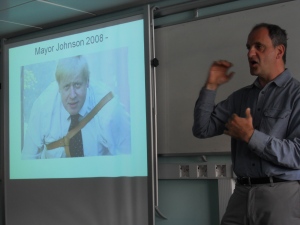
RDRF Chair Dr. Robert Davis was privileged to give not just one but two papers at this conference hosted by Drs. Dave Horton and Aurora Pereira-Trujillo at the Centre for Mobilities Research last month. One was on the general principles of Road Danger Reduction, the other on cycling in London (see photo above: I’m the one doing something funny with his hands, I can’t remember what). For a report go to http://thinkingaboutcycling.wordpress.com/2010/10/01/bicycle-politics-workshop-report/ and while you’re there, take a look at Dave Horton’s blog “Thinking about Cycling” http://thinkingaboutcycling.wordpress.com/, particularly the excellent article “Fear of Cycling”.

RD 2nd October 2010

A revealing issue

 bikesmbikes.jpg

Previous posts have described the record of Transport for London and the Greater London Authority under Mayors Livingstone and Johnson with regard to cycling. Whatever the verdict on this record is, there is one two-wheeler group that has done well in London since 2000 – motorcyclists. Motorcyclists have profited from virtually unhindered access to supposedly cycle-specific facilties such as Advanced Stop Lines and cycle gaps in road closures. Press attention is drawn to pedestrians killed in collisons with cyclists, but not the larger number in incidents involving motorcyclists. While cycling is persistently portrayed as hazardous, motorcycling – with far higher casualty rates – is not.

TfL’s pro-motorcycling agenda is shown up well in the saga of allowing motorcyclists into bus lanes.  While the details may tend to bore all but the most hardened transport professional, this episode tells us a lot about how some road user groups can get their way, irrespective of the evidence supposedly required to justify legal changes. Time and again we can see in the history “road safety” how a safety benefit is consumed as a performance benefit. In this case it is even dubious whether any safety benefit for the measure taken has ever existed: we simply move to the performance benefit (of motorcyclists having extra road space) while using “road safety” as a justification.

 Below Colin McKenzie summarises the latest stage in this story: Continue reading

What "treachery" of snow and ice?

This might surprise you, particularly as we read of collisons involving road users on icy roads. And for those who will really have to travel by road, yes, we sympathise.


But I submit that the word “treacherous” employed to describe difficult conditions is misplaced – and looking at this (ab)use of language tells us a lot about travel on the road, and not just the safety of it. For us at RDRF, speaking English, rather than “road safetyese” is very important. “Treachery” in  the current discussion implies an immutable right to drive as far as is desired, when, how and for whatever reason – and that if the environment does not allow you to do that with convenience and safety, it has “betrayed” you.


For a superb discussion of how a hypermobile, car-based society views the weather conditions that are an inevitable fact of life, we suggest you read Simon Jenkins in the Guardian on http://www.guardian.co.uk/commentisfree/2009/dec/22/blame-for-winter-travel-chaos  Continue reading

Let's get rid of "the vulnerable road user"

By which I mean, of course, the term “vulnerable road user”…

  Mae-West-569x768-77kb-media-882-media-85070-1068107101

“Men are always trying to protect me, I wonder what they are trying to protect me from…”. Mae West

A lot of colleagues think that it is helpful to refer to pedestrians (particularly children and elderly people) and cyclists as “vulnerable road users”. I disagree: seeing people who just happen to be outside metal boxes as being special easily morphs into seeing us AS A PROBLEM.  It is often connected to what has been referred to as the “Fear of Cycling”. It misses out on the elephant in the room – or what the excellent Mikael Coville-Anderson of Copenahgenize.com refers to as “The Bull in the China Shop”. Continue reading

Oh no, not seat belts again…

You might think that discussion about compulsory front seat belt legislation in the U K (introduced 26 years ago and confirmed 3 years later) is about the last thing that those of us interested in safety on the road should be considering at the moment.

Surely there is no need for detailed statistical discussion about this event, still less questioning what has become a – or the – major triumph for those officially charged with safety on the road?

But no. A recent debate has seen the proponents of compulsory bicycle helmet use drag the issue out again – and this time some revealing facts have been shown up. Some uncomfortable truths about the effects of the seat belt law in the UK  and the  “road safety” establishment  have critical relevance to everything that those of us working for safety of all road users should be aware of.

So, if you’re interested in real road safety, do read on… Continue reading

"A Safer (sic) Way: Making Britain’s Roads the Safest (sic) in the World"

The Department for Transport has produced a crucial document:  “A Safer Way: Making Britain’s Roads the Safest in the World”  which will be the basis of future national “road safety” policy after 2010. Our response to the consultation document is here: the DfT have also kindly allowed us to post the document (with our comments inserted in the text) on our site here.

As this document is of such central importance, it is important to be aware of it. For us, there is one significant move in the right direction (the adoption of the “rate-based” target for cyclists and pedestrians); one or two other minor improvements; a few things we are more or less sympathetic too – and the rest is the same old, er, same old. (Who says we can’t be polite?). We are basically opposed to a fundamentally flawed approach to understanding what danger on the road is – and what to do about it – throughout “A Safer Way”, specifically, the continued:

* Failure to properly define “safe roads” (allowing, for example, more hazardous environments to be defined as “safer”).

* Denial of adaptive behaviour (risk compensation) by road users.

* Inability or refusal to differentiate between endangering or killing/hurting  others on the one hand, and being endangered or killed/hurt on the other.

* Failure to approach the standards of other relevant safety regimes and oppose rule and law breaking driver behaviour.

* Commitment towards unsustainable transport policy and car dependence.

In fact, it shows just how far away government is from grasping what road safety policy should be about, and why the RDRF is needed. So do have a read of it and our response.