
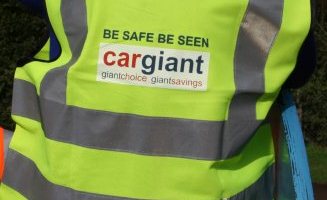
ABOVE: West London car retailers cargiant have sponsored children wearing hi-viz to walk to school.
A couple of bloggers have recently raised the issue of “road safety” professionals pushing hi-viz wear and devices for pedestrians as well as cyclists. The politics of the conspicuity con is dealt with in Chapter 9 of my “Death on the Streets: cars and the mythology of road safety” (1992) . Here I discuss how this kind of “road safety” initiative is not just without an evidence base, but actually becomes part of the problem it is supposed to deal with. The reference to “slutwalks” should become clear.
Mikael Colville-Andersen gives an interesting account of how “road safety” personnel push hi-viz in his son’s school. Mikael rightly reports the lack of evidence to show actual beneficial changes in casualty rates as a result of this kind of programme. There is one rather ropey Norwegian study referred to, but even the UK Department of Transport has indicated that there is a lack of evidence to justify hi-viz for cyclists. Mikael states – correctly – that people genuinely concerned with safety on the road should deal with what he calls “the bull in the china shop“, namely danger from motorised traffic, which they don’t.
But it is worse than that. I would argue that a key reason why motorists feel they can get away with justifying bad driving is the “Sorry Mate I Didn’t See You” (SMIDSY) excuse. (See the CTC’s campaign against SMIDSY).And this excuse is facilitated by precisely the kind of campaigns which put the onus of responsibility to “Be Seen” on the least dangerous to others, rather than requiring those who are dangerous to others to watch out for their potential victims.
The most basic rule of safe driving, in the Highway Code and elsewhere, is to “Never drive in such a way that you cannot stop within visible distance“. But this is eroded, not just by failure to have proper speed limits and their compliance, but by the assumption that if motorists don’t “see” their victims, it is the victim’s fault. Whether by lengthening sight lines or other measures, the underlying belief system thrusts the onus of risk on to motorists’ actual or potential victims. It is not just a lack of speed control, or the failure to weed out motorists who can’t see where they are going. It is a general culture – promoted by the “road safety” lobby – that you don’t have to fulfil a responsibility to properly watch out for those you may hurt or kill.
I emphasise “watching out for” because what is required is a thorough process where drivers consider the possible positions of those they may drive into, think about their need to avoid doing so, and drive accordingly. The image of a pedestrian or cyclist on the retina of the driver is just the first part of this process. And the key element is searching – watching out or looking out – for these people in the first place. It is an active process which is far more effective than any amount of hi-viz, which may be irrelevant anyway. I am regularly told by motorists that they see plenty of cyclists without lights at night. Indeed: if they are driving properly (albeit in an urban area with street lighting) they will indeed see unlit cyclists.
Let me be quite clear about this. My argument is not just that this is rather unsavoury victim-blaming and morally objectionable. It is that it exacerbates the very problem it claims to address. In ten years or so these young people may become drivers with the expectation that others should shoulder the responsibility that they as drivers have. The official “road safety” response to this criticism is – to avoid it. The typical answer is this: “Of course, motorists should watch where they are going, and we may have an advertising campaign to politely ask them to do so, but in the meantime wear hi-viz”. The problem with this is twofold: firstly, this “in the meantime” has been going on for over a century of motorists endangering, hurting and killing others, and that polite requests aren’t going to do it. But the second point is the more important: the relentless shifting of responsibility away from those endangering others becomes part of the problem.
“Take it to Make It”
The second post that sparked a desire to comment on the conspicuity con is in the “Take it to Make It” video and here
. Do note the slogan: If you don’t take it, you may not make it. And guess whose fault that’s going to be?
Slutwalks
This year Guardian readers and others have been debating the Slutwalk phenomenon . I won’t go into these debates here (personally, I don’t quite see how a word like “slut” can be “reclaimed”) except to note two key messages that Slutwalk supporters have been making. These are that:
1.There is no evidence to link the nature of a woman’s clothes with the chances of being assaulted.
2. Insofar as there is any connection between women’s clothing and the excuses made by rapists it is just that: excuses. Furthermore, if a belief system contains the idea that women’s clothing is a key factor in generating rape, then that belief facilitates rape, is dangerous, and suggests that the belief system needs some critical evaluation.
Is there some connection between ideas around women’s clothing as a factor involved in sexual assault and those around hi-viz and pedestrians and cyclists being knocked down?
Now, I’m not suggesting that you should never wear bright clothing when cycling. Nor – of course – that carelessly knocking a pedestrian down with a car is the same as sexual assault. An analogy is just that – an analogy, which I hope stimulates productive thought

 Road Danger Reduction Forum