Author Archives: rdrf

“Dear Rachel Reeves…”: An open letter to the Chancellor on why she should increase the price of driving in her Budget 2025.

Dear Chancellor,

Please consider the increases in the financial costs of driving described below in your Autumn Budget 2025 for the following reasons:

  • Raising significant much-needed revenue for the Exchequer.
  • Sending a “price signal” to highlight the adverse consequences of driving on society, specifically public health and our local and global environments.
  • Fulfilling the Government commitment to decarbonise transport and reach Net Zero requires this (amongst other measures) in the road transport sector.
  • The burden of additional expenditure will fall more on the wealthier motorists. While the recommended price increases are indirect, they are only as “regressive” as the much larger tax take from VAT, and will be paid more by people with greater personal income and wealth.
  • You will not be breaking any promises not to raise VAT or income tax.
  • Reducing the amount of driving through raising the cost of driving to motorists reduces the need for more road building, thus saving the Exchequer the massive financial burden involved.

Below I describe the background to this issue and the justifications for significant increases in the cost of driving to motorists.

Revenue raised from driving

(Note that all figures below are approximate and refer mainly to car and van drivers. Exceptions may have to be made for some necessary road freight deliveries and types of drivers such as low-income drivers in rural areas dependent on car transport, some people with disabilities etc.)

It must be emphasised that as a proportion of economic activity subject to taxation (in 2024/25, the UK’s public sector current receipts were approximately £1,136 billion), or Gross Domestic Product (of c. £3 trillion), the tax take from private motoring is small: there are expected revenues of £24.4billion from fuel duty in 2024-25, with a halving from EVs replacing ICE cars and vans likely by the 2030s, and receipts close to zero by 2050. Additional forms of taxation are VED – £8.4 billion in 2024/25 – and VAT on new cars and fuel. These raise total taxation on private motoring to between £35 and 40 billion per year. (The higher amount includes road freight, taxis etc.).

This means that car and van drivers only pay some 3% of the annual tax take, and 1.2% of GDP, despite car and van usage being a major expense for car/van users.

The “regressive tax” issue

Fuel duty and the proposed per-mile tax on electric vehicles are not, strictly speaking “regressive” as they are not imposed in such a manner that the tax rate decreases as the amount subject to taxation increases. Nevertheless, there is a legitimate concern that people on lower incomes will pay a higher proportion of their disposable income on driving with such taxes. This is largely misplaced, as the poorest (especially in urban areas) either don’t drive or drive less than wealthier motorists.

Besides, if there is opposition to paying any form of tax which is not “progressive”, you would have to cancel or at least reduce Value Added Tax (VAT), which brings over £170 billion annually to the Exchequer. In addition, paying for driving can be morally justified by the massive external costs of driving – “polluter pays” is a idea well-understood by the public, and can be applied here.

“Polluter pays” and the external costs of driving

There are significant moral issues around assigning economic costs to matters such as the costs of road crashes, deaths and poor health from bad air quality etc. Nevertheless, economists in the Department for Transport and elsewhere calculate such costs. These “external costs” of driving are valued at significantly more than the tax revenue obtained from drivers, even in cost-benefit analyses and conventional economics, for example as shown in this academic study from 2012.

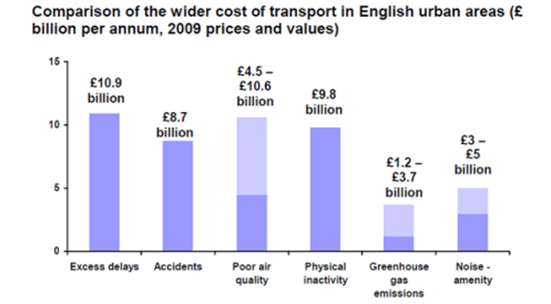
Or you can look at the report from November 2009, by the four relevant Government Departments (Health, Transport, Environment, Communities and Local Government) and the Cabinet Office:  “ The wider costs of transport in English urban areas in 2009”  which showed tax revenues significantly below the external costs to society, meaning in effect that driving receives a net subsidy, rather than taxation.

Here is the graphic presentation of the report:

Note that over the last 16 years these costs will have generally increased, with greenhouse gas emissions in particular costing more. Furthermore, other costs are not mentioned:

  • Road Danger – which is different from the aftermath of crashes (not “accidents”) – dissuades parents from allowing their children to walk and cycle as well as intimidating actual and potential users of Active Travel.
  • Space consumption by parked cars prevents more benign uses of land.
     such as housing, or much-needed green space in deprived areas.
  • Road building costs a great deal economically as well as environmentally.

Or you can look at mainstream think tanks, such as in this report from the IPPR in 2012 saying:

“Put simply, there is no war on motorists. Fuel duty and VED are both effective and justifiable motoring taxes that not only encourage greater fuel efficiency but go some way to offsetting the environmental and social costs of motoring. Recent government reductions or delays to planned increases in fuel duty in particular are not justified in terms of sound public policymaking.”

“This paper has examined the claims that motoring taxes are too high and that insufficient revenue from them is spent on roads. We conclude that neither is true.”

Or consider opposition to increasing subsidy to drivers in 2014 by one of your predecessors, Mr Osborne, here.

You can also compare the costs of driving (to the user) to those of public transport, particularly bus and coach use.

All this provides you with economic justification for significant increases in the price of driving.

Furthermore, any serious attempts to counter projected increases in motor traffic (with attendant increases in the external costs described, not least with regard to your Government’s commitment to Net Zero) will require disincentives such as significantly increased costs of driving to the user.

So how much should the cost of motoring go up by?

Ideally you should announce a commitment to introduce methods of charging drivers in urban areas (where congestion poses a particular problem) by enabling local authorities to use schemes such as Workplace Parking Levies and above all Pay per Mile Smart Driver Charging. As your Cabinet colleagues can tell you, the issue of charging drivers in urban areas (under names such as “Road Pricing”) has been discussed by civil servants and academics for some 60 years.

In the first instance, there are two specific areas where taxation should be increased:

Electric Vehicles (EVs)

Due to Internal Combustion Engine (ICE) cars and vans being replaced with EVs, from expected revenues of £24.4bn from fuel duty in 2024-25, a halving is projected by the 2030s, and receipts will be close to zero by 2050. According to the Office for Budget Responsibility This is an average £15.5bn a year lost in fuel duty receipts, driven by the assumption all new cars and vans will be zero-emission by 2035 and new HGVs [heavy goods vehicles] by 2040…”

However, replacing revenue lost by the switch to EVs should not be the only, or indeed main, reason for such taxation. Don’t forget that costs to society of congestion, health disbenefits to users, danger and collisions, space consumption etc. for EVs are the same as for ICE cars and vans. Also the main advantage of EVs – lower greenhouse gas emissions – does not mean that the greenhouse gas emissions from EVs and associated measures are zero, as explained here.

Therefore, we suggest that rather than the 3p per mile charge being discussed (raising some £250 p.a. per car/van), an amount at least 3 times higher should be considered. 3p is utterly inadequate for making drivers reconsider making journeys by car, and does not begin to cover the external costs of driving, even with the fuel being clean electricity. If this suggests that drivers may delay moving to EVs from ICE vehicles, the answer is to raise the cost of using ICE vehicles.

Internal Combustion Engine (ICE) cars and vans

In the first instance we suggest that you cancel the freeze on the Fuel Duty Accelerator brought in by the Conservative/Lib Dem government in 2011. At present the average car/van driver pays £600 p.a., which is insufficient to either encourage drivers to make journeys by more sustainable and healthy modes, to counter the external costs described above, or even to encourage use of more fuel-efficient vehicles.

Drivers should also be informed that they have not “paid for the road” (often citing a “Road Tax” which has not existed since 1937): this is not just necessary as part of the justification for highlighting the problems due to driving on society as a whole, but to address the prejudice of all too many drivers that they “own the road” and have more right to be there than pedestrians or cyclists.

After unfreezing the Fuel Duty Accelerator, there can be further increases in duty on petrol and diesel: you can show that this would reduce the prospective increases in motor traffic, cut the external costs associated with this, address some of these costs, and also raise much-needed revenue.

CONCLUSION

We hope this demonstrates that significantly increasing the cost of motoring, primarily through pay-per-mile for EVs and raising the price of petrol and diesel fuel is justified and necessary.

Costs of driving to society as a whole, in terms of public health and the local and global environment, should be seriously considered in such discussions: we need to spend time thinking what driving costs other people and the wider society, rather than just the user of the vehicle.

You will also be able to raise much needed revenue, and we trust that you do so by, in the first instance:

  • Placing a 10p per mile charge on electric (EV) cars and vans.
  • Unfreezing the Fuel Duty Accelerator.

Dr Robert Davis, for the Road Danger Reduction Forum, 17th November 2025

What’s going to be in the Government’s Road Safety Strategy – and what should be?

As is common nowadays, the Government’s Road Safety Strategy (RSS) has had elements in it “leaked” to The Times on August 10th , and as described in this article in the Guardian. Our Manifesto for what should be in a new RSS is here : below is a list of what has been leaked, what we think about these measures – and a surprising agreement between us and the motoring lobby!

(Go to Page 2 to continue reading)

What is “dangerous”? The measurement issue and the case of cyclist deaths in the Netherlands compared with the UK.

In 2024 the main annual national “road safety” conference featured a presentation by Mr V. Stops arguing against Britain emulating the Netherlands (NL) high share of cycling on the basis of the numbers of cyclists killed in NL. This was re-published in Local Transport Today (although editorial staff were keen to say that it’s message was not endorsed by LTT). There was then a riposte to it by Simon Munk, and one issue later by myself here which is posted here.

Why post this now?

This may seem to be either a rather arcane discussion about metrics, or else what Basil Fawlty may have described as “stating the bleeding obvious”. But it is crucial to any understanding of what the problem of danger on the road to be clear what we are trying to measure: is it danger, risk, officially reported casualties (in this case deaths) or casualty rates – all of which are different things. As discussed below, these numbers can be presented to get to not only the wrong, but diametrically opposed, conclusions. That’s why we post this article here: it is crucial to be clear what we think the problems are, so that we know what we should trying to achieve. (See also this article LTT kindly published as well.)

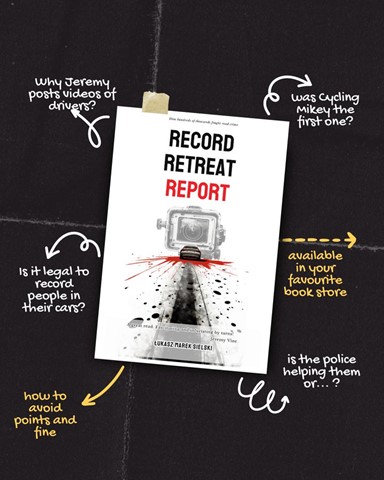
REVIEW: “Record; Retreat; Report” by Lukasz Marek Sielski.

Road Danger Reduction Forum: Manifesto 2024

1. Move UK away from dependence on private motor transport, which is unsustainable, wasteful, unsafe and is a deterrent to walking and cycling, by incentivising sustainable, active travel and public transport and by deterring unnecessary motor vehicle use by road pricing.

2.   Cut the road building budget (c. £7 billion*) and reallocate for sustainable transport including:

£2 billion p.a. for Active Travel routes to deliver target of 50% of urban trips on foot or by bicycle by 2030.

3.   Enforce road traffic law effectively through a substantial increase in roads policing, including national support for 3rd party reporting, with emphasis on minor penalties for common offences implicated in causing death and injury to others. Allocate an additional £500 million p.a. to be spent on road traffic policing.

4.   Implement a National Road Safety Strategy with headline targets to reduce the danger that road users can pose to others, the establishment of a Road Safety Investigation Branch and lower speed limits with default of 20mph on urban roads and 40mph max on country lanes.

5.   Legislate for and incentivise use of smaller, slower, safer, sustainable motor vehicles for passengers and freight. Taxation should be based on vehicle size, weight, and fuel with an objective being the reduction of use of SUVs in urban areas.

6.   Commission a review of all road traffic laws to secure “road justice”.

********************************************************************

Road Danger Reduction Forum President Baroness Jenny Jones said:

Victims of road crashes – whether those injured or those who have lost loved ones – suffer appallingly, not least with an often overly lenient attitude in the justice system. The only civilised approach to this is to reduce danger at source – from those with the potential to hurt or kill others”, says Baroness Jones.

Measures to curb road danger have to be part of a transport policy – unlike the one we have had for decades – which is less car dependent, and which supports active and less polluting forms of transport: this can also cut the deaths from inactive lives and vehicle emissions, as well as those from road crashes.” 

It’s not right to expect children to wear body armour and high visibility clothing to (supposedly) protect themselves, while adults with a ton of metal around them are permitted to get away with dangerous and unnecessary driving which scares them off the streets.”

For further information, or if you want your organisation to sign up to the Manifesto, contact:

Dr Robert Davis, Chair RDRF, at chairrdrf@aol.com

We’ll be commenting further here and on @CHAIRRDRF about other Manifestos, why ours is different and what we have in common. 19th June 2024

  • *The 2nd Roads Investment Strategy (RIS2) was £27.4bn when it was first announced in March 2020 (and that was to cover the 5 years from April 2020 to March 2025)to £24bn in the October 2021 Spending Review. About £14.1bn of it was for actually building new road capacity. The roads budget for beyond March 2025 (i.e. RIS3) has yet to be set – we believe that there should be a presumption against creating new capacity which will induce or generate more motor vehicular traffic.

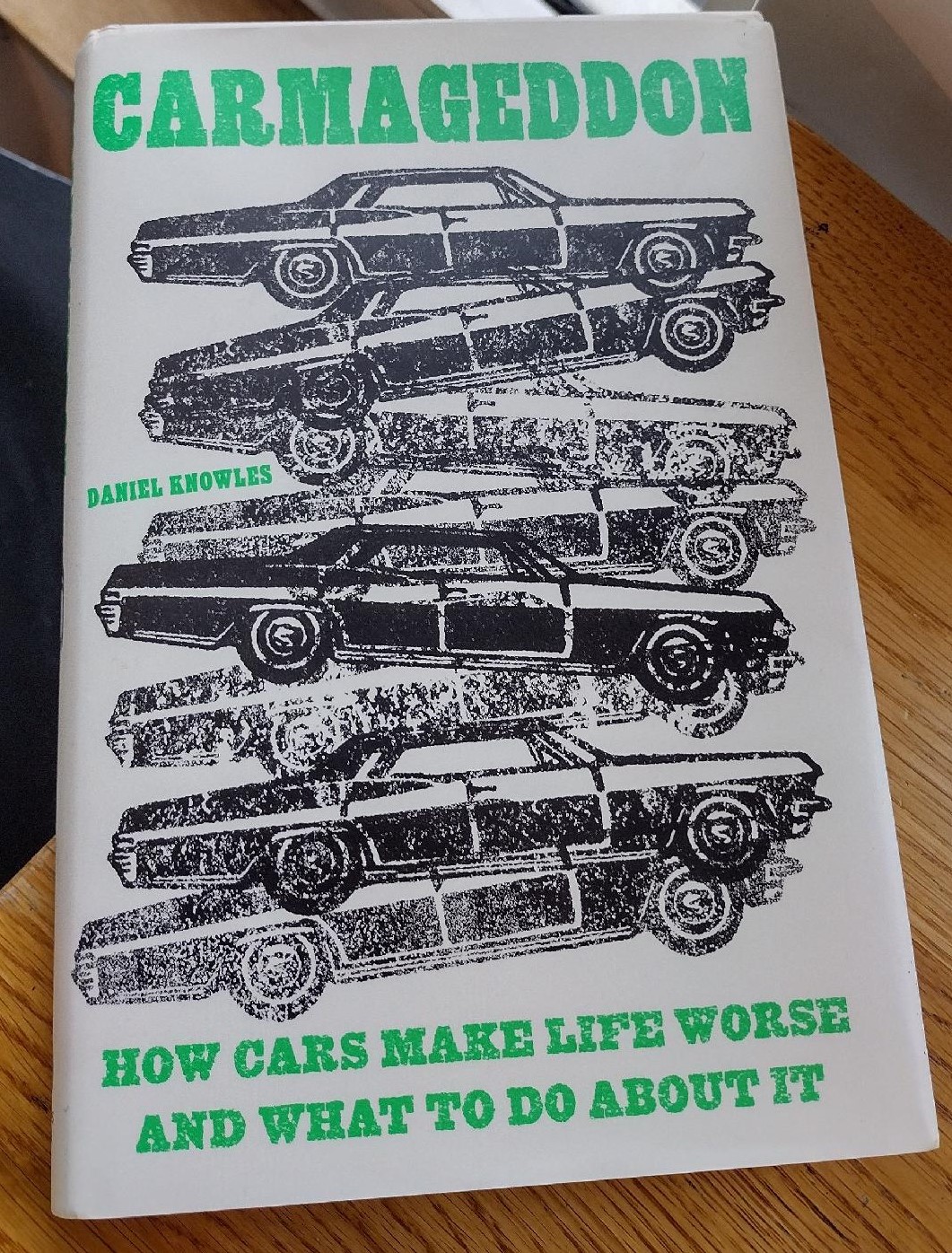
BOOK REVIEW: “CARMAGEDDON: How cars make life worse and what to do about it” by Daniel Knowles

This is an absolutely “must read” book for anybody trying to make sense of a car dependent society and working out ways to mitigate the adverse effects of car use. The author is an experienced and proficient journalist basing his work on worldwide case studies in an easy to read style: making things simple without being simplistic. I disagree on a couple of minor points (HS2 is one), and there’s one big flaw in the structure of the book (wait for it!), but you really should read this book if you have any interest in road transport.

We’re still here and busier than ever!

RDRF supporters may have noticed that there has been an absence of blog posts here (leaving aside a book review and details of our conference) for two years. That doesn’t mean we haven’t been active – far from it. The main reason for no posts is that my activity in monitoring and responding to transport issues formed during the COVID-19 crisis has been through the weekly webinar for Active Travel professionals and campaigners www.ideaswithbeers.co.uk  (more of which below).

And our other RDRF Committee members have been busy with:

Brenda Puech: Continuing work as a disabilities/inclusive access consultant and carrying on her pioneering work on Street Parklets with London Living Streets.

Lucy Marstrand-Taussig: Lucy has been working as a consultant for Active Travel England, specialising in work with women and children.

Ken Spence: With the Transport Initiatives team Ken has been working on Local Authority Local Cycling and Walking Implementation Plans (LCWIPs).

Colin McKenzie: The team at LB Ealing he works in has implemented wand-protected (light segregation) cycle lanes on main roads, and despite a pull back on LTNs, some with key cycle route links in Ealing have been retained.

Ideas With Beers

While working in Manchester, Brian Deegan (long term highway engineer working on creating cycling and walking friendly environments) had an informal discussion session for engineers and other colleagues after work. When the first lockdown hit and the transport world was buzzing with measures taken worldwide to re-allocate road space, this shifted to an online weekly webinar.  The name chosen, as the first real world meetings were held over a post-work drink, was “Ideas With Beers” – but we make it clear that drinking is neither encouraged nor typical by attendees! Each session starts with yours truly providing a weekly news update on developments.

This has essentially been a series of updates from news presented in posts like https://rdrf.org.uk/2020/04/11/transport-in-the-time-of-the-coronavirus-crisis-what-we-need-to-do-now/ and June 3rd 2020 – Crunch time for Active/Sustainable Travel in the UK | Road Danger Reduction Forum (rdrf.org.uk) . Along with my news updates, including links to numerous reports published during this time, we have had a number of speakers presenting on what has happened with regard to provision for Active Travel. Videos of the sessions and the slide presentations are archived on the IWB web site.

Indeed, the last two years has been a time of great hopes – and not a few disappointments – for those pursuing the Road Danger Reduction, Active Travel and Sustainable Transport agenda. The declared aim from central Government of re-allocating road space to walking and cycling that came in May 2020 with Gear Change https://assets.publishing.service.gov.uk/government/uploads/system/uploads/attachment_data/file/904146/gear-change-a-bold-vision-for-cycling-and-walking.pdf   (backed up a year after with https://assets.publishing.service.gov.uk/government/uploads/system/uploads/attachment_data/file/1007815/gear-change-one-year-on.pdf ) is the most radical Governmental change to a transport policy agenda based simply on providing for more and more cars.

That led to the kind of enthusiasm from transport professionals and campaigners that has formed in a community that meets at Ideas With Beers (as well as in gatherings like the Landor Conferences Walking and Cycling conferences, Transport Planning Society etc.) So do join in by getting details from www.ideaswithbeers.co.uk and if you can’t make Tuesdays at 5 pm, check out the videos and slides from previous issues.

Onwards!

RDRF is also involved in providing training sessions in Road Danger Reduction – what it is and how it differs from traditional “road safety”. There is a lot of interest out there, and some positive moves such as the (ongoing) formation of Active Travel England, the setting of a default 20 mph limit by the Welsh Senedd, and positive noises from the devolved government in Scotland. But then we have also had the disappointments of COP 26 and the continuing commitment to road building in the UK through RIS2 and probably RIS3…

So, it’s all to play for. RDRF is as committed as ever and we hope you’ll be with us for the journey!

Dr Robert Davis, Chair RDRF, 10th August 2022

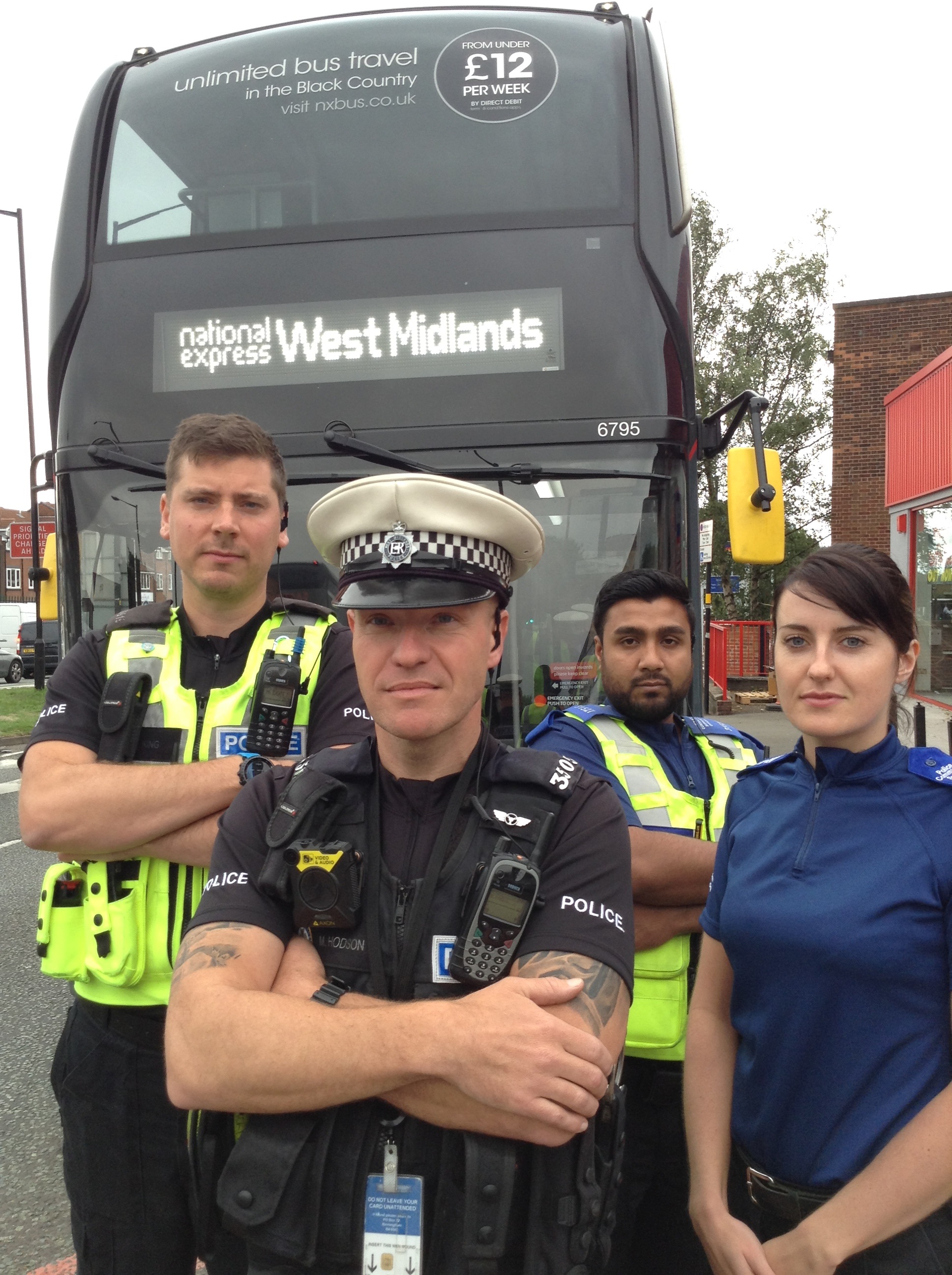
West Midlands Police Road Harm Reduction Team – Setting the Gold Standard for road danger reduction policing

At the “Cycle City Active City” conference in Manchester in July Road Safety Minister Jesse Norman commended the work on policing close passing of cyclists sby PCs Mark Hodson and Steve Hudson of the West Midlands Police Road Harm Reduction Team (WMPRHRT), saying his Department “plans to build on it – it is a very effective way of building awareness and reducing casualties”.

By now readers of posts on this site will be aware of the existence of operations policing the close passing of cyclists and related enforcement based on reducing road danger at source. Our last update of what is happening nationally is here.

This post is about the work WMPRHRT carry out in general. For us they have been setting the Gold Standard for road danger reduction policing with the typical resources (the Metropolitan Police being the exception that proves the rule here) of a Police Service.

Continue reading

REVIEWS: “Building the Cycling City” and “Designing for Cycle Traffic”

Here are two different books which are required reading for anybody thinking about creating cities where cycling is a genuinely mass mode of transport: which, when you come to think about it, is anybody with a view of cities which are less dangerous, polluting (whether it be from noxious, greenhouse gas or noise emissions), unsustainable and unhealthy for those living and working in them.

Continue reading