Time to expose ‘road safety’ misconceptions
When examining road danger, the important metric to consider is casualties per kilometre travelled rather than casualties per head of population, argues Robert Davis
I echo Simon Munk’s splendid riposte 1 to the rather strange piece you published by Vincent Stops 2 on relative levels of danger and casualty/death rates for people cycling in the Netherlands compared to the UK. I write because the bizarre notion in Stops piece – that cyclist safety is worse in the Netherlands, even when the casualty rate is significantly lower, simply because of the casualties/deaths per head of the population is higher – is common amongst “road safety” professionals. In my view (expressed in previous articles for LTT 3) this misconception is part of “road safety” ideology and needs to be opposed.
Let’s consider the Stops article. It is strange, because while he starts off referring to the higher number of deaths per head of the population in NL, he accepts that deaths per km. travelled (historically significantly lower in NL) is a good metric. We might ask why he continues with the deaths per head metric then, not least because we had already been through this in a long discussion on “X” in March of this year 4
This obsession with a road user groups deaths per head of the population is common amongst those supposedly in charge of transport policy: Norman Baker, then an MP was rightly castigated 5 for these comments in 2012:
“I think that my colleague Mike (Penning) referred earlier on to the rate per 100,000 of the population, in terms of cycle deaths, and we actually come above (rather confusingly, he meant “better” rather than “higher” RD) the Netherlands. We’ve got a better record on that”.6.
All a bit strange, unless you’re a politician who just wants to grab at numbers superficially to make your case look good. Then Stops makes the excellent point: “The health benefits of cycling outweigh many times the statistically small chance of death and injury to individuals, therefore public policy rightly aspires to more and safer cycling.” Indeed. For the number crunchers amongst you, try adding up the life years saved from cycling with the modal share that cycling has in NL, and compare that with those lost in road crashes. Wouldn’t it significantly outweigh the life years lost from crashes?7
Of course, road deaths have a uniquely appalling effect on loved ones and others. Road deaths are in our opinion all about the moral issues of endangering, hurting or killing others: this is the issue at the core of the Road Danger Reduction movement’s conflict with traditional “road safety”.
Correcting for age
Now, there is one point which Stops raises where the lower death rate for cyclists in NL compared to the UK (and I’d say everywhere else) seems to be being eroded. Probably due to the increased uptake in e-bike use amongst the elderly, older people are now able to continue cycling into old age (and of course enjoying the health benefits accordingly). Inevitably this means more crashes for these older people, and we oldies are more likely to be killed when we’re in a road crash.
Professor Mindell et al. showed this factor re-cyclists and drivers in NL and UK here 8 with this graphic 9 based on deaths per hours spent travelling. Essentially, if you correct for age and compare like with like (the most basic rule of statistical analysis) the far superior record of NL compared to the UK is restored.

The “problems” of being old and walking
So here is what appears to be the problem for Stops and the traditional “road safety” industry. Allow me to illustrate with two anecdotes from some decades ago.
In the early 90s I ran a project for one of the more progressive people in charge of Highways in a London Borough. He had just completed a major traffic calming project across a large residential area and proudly described to me his achievements in cutting vehicle speeds – although there was a “problem” for him: “The thing is, with lower speeds these old dears are walking about more and getting knocked down
When I interviewed the then head of Road Safety at the Department of Transport in the late 80s, I asked if he would recommend the desirability of encouraging walking to the Minister as it was the safest form of transport in terms of endangering other road users. We spent some time in a non-conversation as he described the pedestrian casualty rates: he was fixated on what happened to pedestrians whereas I was interested in what walking did to other road users.
Morality and the “road safety” industry
The Road Danger Reduction (RDR) perspective has been taken up by those with a genuine concern for the safety and wellbeing of all road users. It opposes the victim-blaming of those without the protection of modern motor vehicles, the so-called “vulnerable road users” – itself a contentious term 10. A key area is selection of the right metrics and use of the so-called “Who/What Kills Whom” metrics 11. (A current example is by CoHSAT for RDR campaigners in Birmingham here 12):

By contrast, I note that Mr Stops is addressing the main annual conference for “road safety” practitioners shortly in a session on, you guessed it, “vulnerable road users” 13 alongside someone considering “the use of LED strips worn by pedestrians on their moveable joints to improve the conspicuity of vulnerable road users.”
Meanwhile, I leave you with the comments of another former Hackney Councillor (who bravely introduced Low Traffic Neighbourhoods and other measures aimed at reducing danger at source) on this matter 14:
“The majority of Dutch cycling fatalities occur amongst the over 65s, and mostly amongst the over 80s in that category. The U.K doesn’t have this challenge because we lock our old folk up in cars.
Death will come for all of us.
Personally, I’d rather go at 88 having hit a pothole on my bike after a few glasses of strong Dutch beer, than die at 89 having to spend a decade hidden away in a care home like we do to our old people in the U.K.”
And a graphic from some years ago:
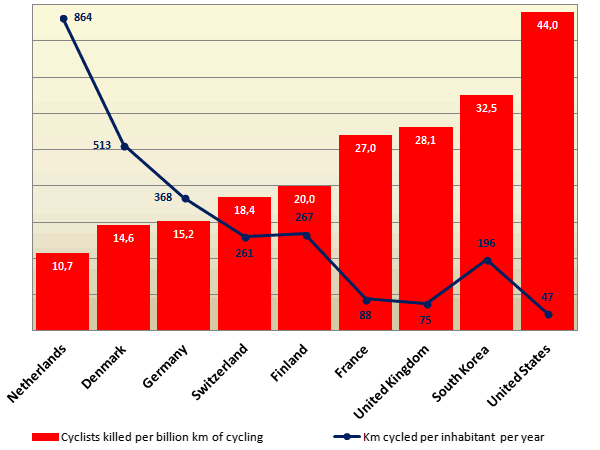
Cycle deaths vs. cycled km. Averages 2006-2009, source: OECD. Graphics © Holland-Cycling.com
Dr Robert Davis, Chair, Road Danger Reduction Forum www.rdrf.org.uk 31/10/2024
- https://www.transportxtra.com/publications/local-transport-today/news/76848/claim-that-netherlands-is-more-dangerous-for-cycling-is-statistical-cherry-picking
- https://www.transportxtra.com/publications/local-transport-today/news/76721/cycling-fatalities-are-rising-in-the-netherlands–so-why-are-we-still-trying-to-emulate-their-approach-to-road-safety-/
- https://www.transportxtra.com/publications/local-transport-today/news/74386/road-danger-reduction-a-basic-moral-issue-that-can-no-longer-be-ignored/ and also https://rdrf.org.uk/2019/07/24/without-tackling-car-culture-we-wont-make-headway-with-road-danger-reduction/
- https://x.com/CHAIRRDRF/status/1773399355887612293
- 5. https://www.theguardian.com/environment/bike-blog/2012/may/25/cycling-governed-dimwits
- https://aseasyasridingabike.wordpress.com/2012/04/24/tthose-baffling-and-misleading-comments-on-dutch-cycle-safety-from-penning-and-baker-in-full/
- For more on the health benefits of cycling see for example Chapter 4 in
https://discovery-pp.ucl.ac.uk/id/eprint/1380581/ Exposure based, Like for Like assessment of road safety by travel mode using routine health data. December 2012. Jennifer Mindell, Deborah Leslie and Malcolm J Wardlaw
- https://pubmed.ncbi.nlm.nih.gov/23227191/#&gid=article-figures&pid=figure-3-uid-2 Note limitations on the illustrations.
- https://rdrf.org.uk/2009/11/13/lets-get-rid-of-the-vulnerable-road-user-2/
- https://rdrf.org.uk/2019/03/12/who-kills-whom-and-the-measurement-of-danger/
- https://cohsat.org.uk/
- https://nationalroadsafetyconference.org.uk/2024-agenda/2024-fringe-agenda-vulnerable-road-users/
- https://x.com/jonburkeUK/status/1780884549381034263
 Road Danger Reduction Forum